

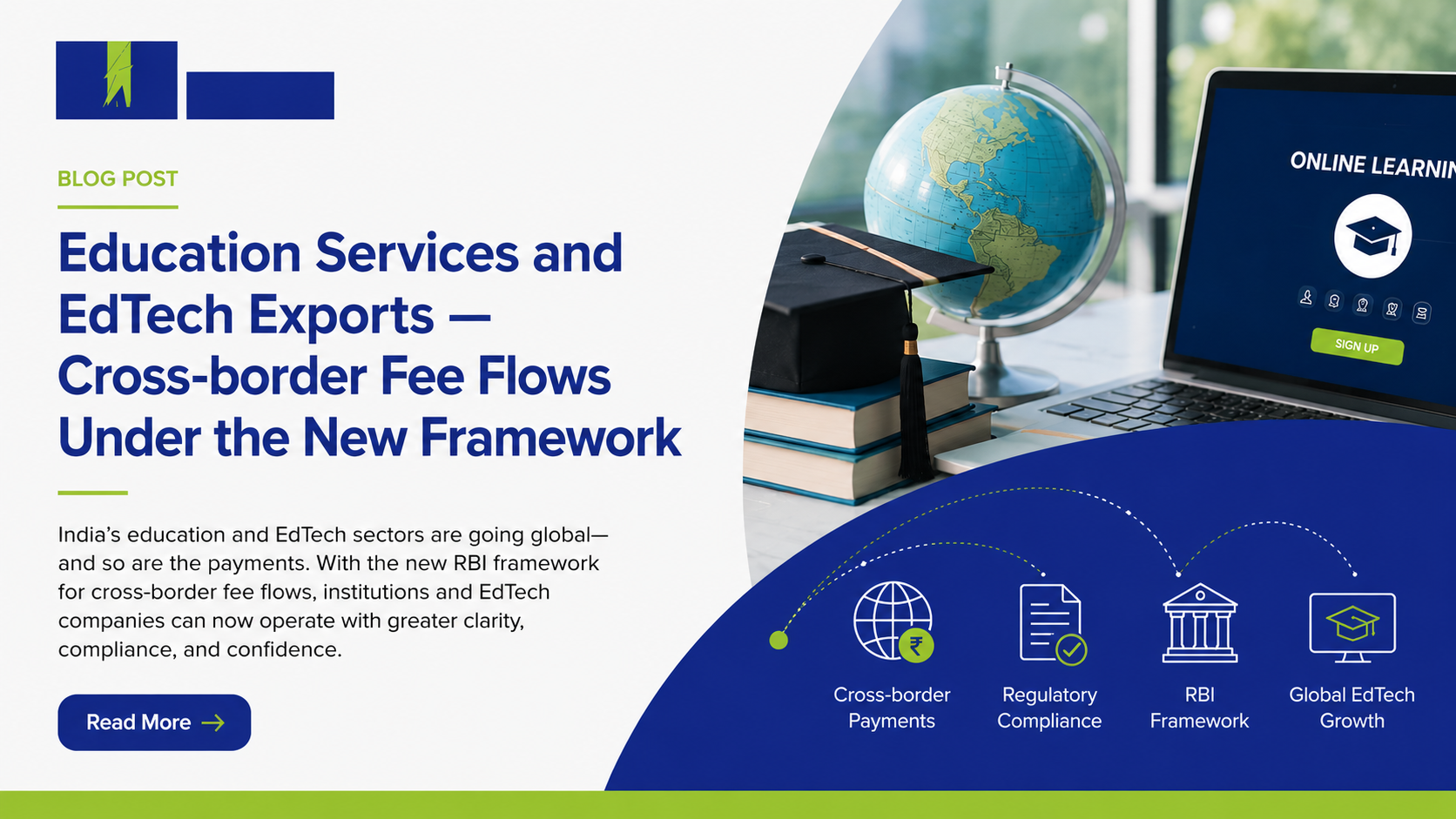
India’s education exports are quietly becoming a serious business opportunity. From solo tutors and test-prep brands to full-fledged SaaS-based learning platforms, more and more Indian education companies are now getting paid in foreign currency by students and corporates across the world.
And with that growth comes one non-negotiable reality: you cannot ignore FEMA, RBI rules, AD banks, and documentation if you want smooth, compliant cross-border fee flows.
India’s EdTech sector has moved far beyond “online classes.” Today it includes coaching apps, learning marketplaces, SaaS LMS platforms, assessment tools, corporate training portals, and study-abroad services selling to students and enterprises in dozens of countries.
Global demand is rising because Indian education services are relatively affordable, digital-first, and available remotely across time zones. Subscription models, micro-courses, and cohort-based programs mean small ticket sizes but steady, recurring foreign revenue.
All of this works only if money can move in and out of India smoothly and legally. That’s where FEMA (Foreign Exchange Management Act), RBI regulations, and your Authorised Dealer (AD) bank come into the picture. A specialist like FEMA Expert helps EdTech founders convert this “regulatory headache” into a predictable, managed process instead of a constant fire-fight.
Any education or learning service provided from India to a customer sitting outside India – and paid for in foreign currency or in permitted INR routes – can qualify as an export of services, subject to conditions under FEMA and GST. In practical terms, this can include:
Why are global learners choosing Indian EdTech? Simple: affordable pricing, digital content that can be accessed anytime, remote learning convenience, and flexible subscription plans make Indian providers attractive in multiple markets.
Once you start selling abroad, your “fee” is no longer just a simple payment. It becomes a cross-border fee flow – money travelling through global payment rails, getting converted into INR, and finally landing in your Indian bank account.
These flows typically look like:
Common channels used include SWIFT bank transfers, international payment gateways, foreign card payments, and wire transfers routed through your AD bank.
Challenges show up quickly: currency conversion at varying rates, delayed settlements, gateway-level compliance checks, chargebacks, and of course, ensuring every inward payment is FEMA-compliant and properly documented.
FEMA is the law that governs how foreign exchange moves in and out of India. For you as an EdTech or education service provider, a few simple ideas matter:
RBI is gradually shifting to a more unified, digital framework for export and import payments, including services, under the new 2026 regulations. For service exporters, this means more standardised reporting and clearer expectations, but also better data visibility for regulators.
Your Authorised Dealer (AD) bank is your “gateway” into the FEMA system. Only AD Category I banks can handle most export-related foreign exchange transactions and issue key documents like e-FIRC.
In cross-border education payments, your AD bank typically:
Common pain points for EdTech companies include wrong purpose codes, delayed inward remittance verification, subscription-level reconciliation issues, and back-and-forth for documentation. Clean invoicing, consistent description of services, and proactive coordination with your AD bank remove a lot of friction.
Global Capability Centres (GCCs) – captive units of multinationals set up in India – are increasingly shaping the education and learning landscape. They look for:
For Indian EdTechs, GCCs open doors to enterprise learning deals, global certification partnerships, and multi-year B2B contracts. The flip side: contracts, invoicing, and cross-border payment structures often need careful work so that FEMA, transfer pricing, and group-company payments all align properly.
This is exactly where structured documentation and advisory support become critical – especially if contracts are tripartite or involve overseas group entities.
In global payment ecosystems, banks and regulators are increasingly sensitive to how long a payment takes to move from a foreign payer to your Indian account. This is essentially what we’re talking about when we discuss transaction timelines and settlement cycles for cross-border education payments.
Read More :- Merchant Trade Transactions (MTT) under the New Framework
From a FEMA perspective, two things really matter:
For EdTechs with subscription revenue, frequent small payments, and student refunds, this becomes a reconciliation puzzle. Strong tracking, clear policies on refunds, and automated reconciliation go a long way in keeping both your accounts team and your bank comfortable.
Under GST, export of services – including most education and EdTech services delivered from India to foreign customers – can qualify as zero-rated supply if conditions are met. This allows you to:
The catch: GST and FEMA have to tell the same story.
Invoices, remittances, FIRC/e-FIRC, and export declarations must match in amount, counter-party, and currency. Otherwise, you risk GST refund queries on one side and FEMA questions on the other. Clean alignment also makes you far more audit-ready.
For education service exports, documentation is your shield. At a minimum, you should have:
RBI and tax officers increasingly rely on digital systems and trail-based scrutiny rather than manual checking. If your documentation is clean and consistent, most reviews become a routine exercise instead of a crisis.
In practice, many high-growth EdTechs trip up on the basics:
Most of these are avoidable with a simple internal checklist and periodic compliance reviews.
A practical, founder-friendly roadmap could look like this:
Do this well and most “surprise” FEMA or GST queries become simple replies backed by documents.
This is where a specialised partner like FEMA Expert fits in. For EdTech and education businesses, support usually spans:
The benefits are very tangible: lower compliance risk, faster realisation of fees, fewer disputes with banks, and much better preparedness for any audit or regulatory review.
Looking ahead, several trends will drive more cross-border fee flows into Indian education:
For founders, the message is clear: compliance is no longer a “back-office chore.” It’s part of your core infrastructure for going global.
Cross-border education exports can be hugely rewarding, but they need structured FEMA, RBI, and bank-level compliance to stay safe and scalable. Clean fee flows, strong AD bank coordination, and disciplined documentation are now as important as your product roadmap.
With GCC partnerships, corporate learning deals, and global students, Indian EdTech companies have a genuine chance to build global brands from India. And by partnering with a specialist like FEMA Expert, you can navigate international payment regulations confidently while focusing your energy where it truly belongs – on building great learning experiences.
Yes. The moment you receive money from a student or company outside India in foreign currency (or via permitted INR routes), FEMA applies. Even small amounts must flow through authorised channels and be properly documented.
An FIRC or e-FIRC is proof from your AD bank that foreign money has been received into your Indian account. It is often required for GST refunds, export benefits, and to demonstrate that your export income has been legitimately realised.
RBI frameworks require export proceeds to be realised and brought back to India within specified timelines; recent guidance and the upcoming 2026 regulations converge around a standard 15-month window, with longer periods where exports are settled in INR. Chronic delays without explanations can lead to compliance issues.
Yes, if the learner or client is located outside India, the place of supply is outside India, and payment is received in permitted foreign currency or INR routes, subscription or SaaS revenue can qualify as export of services under FEMA and GST conditions.
Typical mistakes include using wrong purpose codes, not collecting FIRCs, weak reconciliation of subscriptions, missing written agreements, and letting export realisations slip beyond permitted timelines without taking extensions from the bank.
FEMA Expert can review your existing flows, clean up documentation, align GST and FEMA data, train your team on invoicing and purpose codes, talk directly to your AD bank where needed, and set up ongoing systems so that compliance becomes routine instead of reactive.
Start with three basics: standard international contracts, export-ready invoicing, and a clear mapping of payment gateways and bank accounts to your AD bank’s reporting. Once that is in place, bring in a specialist like FEMA Expert to harden your FEMA, RBI, and documentation processes before scale kicks in.