
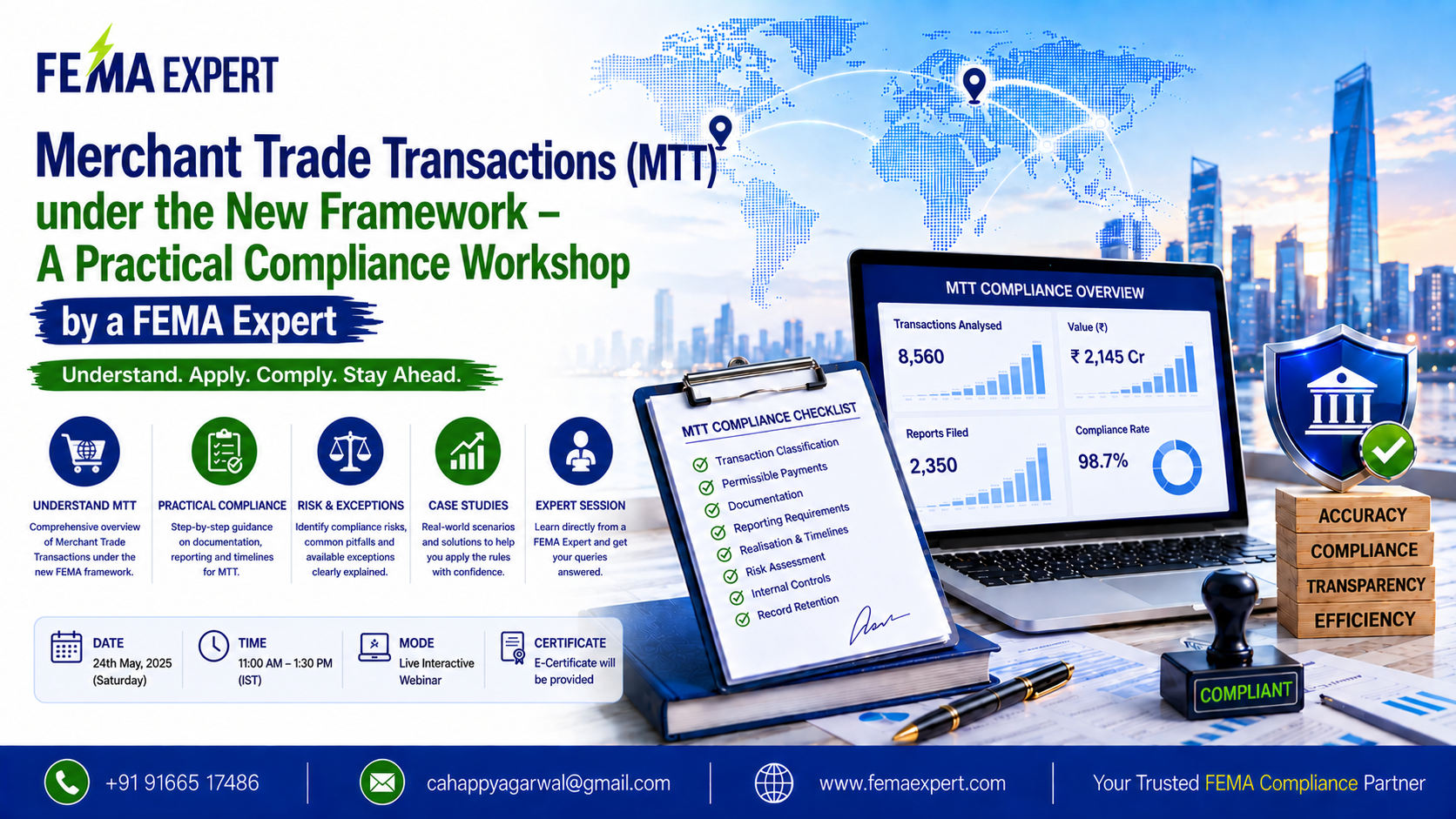
Merchant Trade Transactions (MTT) are becoming a hot topic in international business circles, especially among Indian traders, startups and mid-sized companies looking to expand globally. With the Reserve Bank of India (RBI) tightening and clarifying the framework under FEMA, MTT is no longer something you can handle casually it needs structured compliance, clear documentation and the right guidance from a FEMA expert.
Below is a practical, workshop-style guide that mirrors what you would learn in a hands-on FEMA advisory session.
Global trade today is not just about directly importing into or exporting out of India; a large share of deals now involve Indian businesses acting as intermediaries between two foreign parties. This is where Merchant Trade Transactions (MTT) come in.
In simple terms, an MTT is a transaction where goods move from one foreign country to another, but the commercial and payment flow runs through an Indian entity sitting in the middle. With RBI issuing detailed merchant trade transaction guidelines under FEMA, compliance has become more structured, monitored and documentation-driven. For many businesses, the fastest way to understand and implement these rules is through a practical compliance workshop led by a FEMA expert who lives and breathes these regulations every day.
Under FEMA, a Merchant Trade Transaction is where an Indian intermediary buys goods from an overseas supplier and sells them to an overseas buyer, while the goods never enter India’s Domestic Tariff Area (DTA). Both the import leg and export leg are cross-border, but the margin, risk and forex flows belong to the Indian merchant trader.
This is different from a regular import/export where goods physically cross Indian borders and trigger customs, duties and GST. In MTT, the goods move directly from, say, China to Dubai, while the Indian company handles purchase orders, invoices and payments in foreign currency and earns its profit as the difference between the buy and sell price.
Merchant trade transactions are governed primarily by the Foreign Exchange Management Act, 1999 (FEMA) and a series of RBI circulars and now consolidated EXIM regulations. The law focuses less on customs and more on how foreign exchange flows in and out of India, whether the trade is genuine and whether timelines for realisation and payments are being met.
Authorised Dealer (AD) Category-I banks play a gatekeeper role: all receipts and payments for a merchant trade transaction must go through the same AD bank, which must verify documents, perform KYC and ensure that both legs of the trade are bona fide. Businesses that ignore FEMA rules risk delayed payments, blocked remittances or even penalties if export realisation timelines are breached.
Earlier, MTTs were handled mainly through scattered RBI circulars with limited clarity on timelines and documentation. The newer framework and consolidated EXIM guidelines bring three major shifts:
Any Indian entity with a valid IEC (Importer Exporter Code) and genuine trading credentials can undertake MTT, subject to FEMA rules and RBI guidelines. AD banks often look at past performance, financial strength and the ability of the merchant to actually handle the obligations under the contract.
MTT is not allowed for prohibited goods under India’s Foreign Trade Policy, and restricted items need specific approvals. Jurisdictions on FATF high-risk lists, sanctioned countries, or structures that look like pure financial layering without real trade can be rejected, making due diligence on buyers and suppliers non‑negotiable.
A typical merchant trade transaction workflow looks like a live case study you would walk through in a FEMA workshop:
Common mistakes include mismatched contracts, third‑party remittances, unclear shipment dates, and export realisation received after the import payment is already made—issues that can trigger questions from banks and regulators.
Under the new FEMA EXIM structure and RBI guidelines on merchanting trade transactions, compliance is no longer just “documentation for the sake of documentation”. You need:
Maintaining an audit‑ready trail of emails, contracts, amendments and bank advices is now a best practice rather than an option.
From a GST perspective, MTT usually does not trigger a taxable supply in India because the goods never cross the customs frontier into Indian territory. Several professional analyses treat GST on merchant trade transaction as a “no supply” scenario, meaning no GST is charged since neither import of goods into India nor export from India actually happens.
However, the income from such transactions is still subject to income tax, and any associated services rendered in India (commission, consultancy, etc.) may have separate GST implications. This is exactly why your FEMA advisory and indirect tax advisory should speak to each other before you scale up an MTT model.
In real life, even a perfectly drafted merchant trade transaction can run into issues:
Mitigation starts with sound structuring, clear contracts, realistic timelines, and early discussion with your AD bank and FEMA consultant before you execute the deal.
This is where a FEMA expert adds real value, beyond theory. A specialist who regularly handles MTT can:
A practical compliance workshop with such an expert compresses months of trial‑and‑error into a single, action‑packed learning experience.
A well-designed MTT compliance workshop typically mirrors real transactions that Indian businesses are doing today:
Such sessions are valuable for exporters, importers, finance teams, consultants and business owners involved in cross‑border trades.
For a business seriously considering an MTT model, the benefits are tangible:
Whether you attend a workshop or not, you can immediately tighten your internal approach by adopting these best practices:
Merchant Trade Transactions under the new FEMA EXIM framework are a powerful way for Indian businesses to participate in global supply chains without physically handling goods in India—but they come with serious regulatory expectations. With RBI and AD banks stepping up scrutiny on timelines, realisation and documentation, casual handling of MTT is no longer an option.
If you want to use MTT as a sustainable business model, investing a day in a FEMA expert–led practical compliance workshop can save you years of mistakes, blocked funds and regulatory headaches.
Q1. What is a Merchant Trade Transaction (MTT)?
A Merchant Trade Transaction is a cross‑border trade where an Indian intermediary buys from an overseas supplier and sells to an overseas buyer, while goods move directly between foreign countries and never enter India.
Q2. Is MTT allowed under FEMA?
Yes, MTT is permitted under FEMA, provided you follow RBI’s merchant trade transaction guidelines on permitted goods, timelines, single AD bank routing, documentation and export realisation.
Q3. What is the role of AD banks in MTT?
AD banks route all payments, perform KYC and AML checks, verify merchant trade transaction documentation, ensure that import and export legs are genuine, and monitor compliance with timelines and FEMA rules.
Q4. What are the key compliance requirements for MTT?
Key requirements include: routing both legs through one AD bank, ensuring goods are permitted under FTP, completing the trade cycle within defined time limits, realising export proceeds within the prescribed period, and maintaining full documentation and reporting.
Q5. How does GST apply to Merchant Trade Transactions?
In most cases, GST on merchant trade transaction is treated as “no supply” because the goods do not cross Indian customs borders, though related services may have separate GST implications. Always obtain specific tax advice before finalising your structure.
Q6. Why should I consult a FEMA Expert or attend an MTT compliance workshop?
A FEMA expert helps you correctly structure deals, align with RBI guidelines on merchanting trade transactions, coordinate with AD banks, manage export realisation and respond effectively to any audit or regulatory scrutiny.
Q7. Who should attend an MTT compliance workshop?
Business owners, export–import managers, finance and treasury teams, consultants and startup founders involved in international trade or looking to build a merchant trade transaction model should strongly consider attending.