

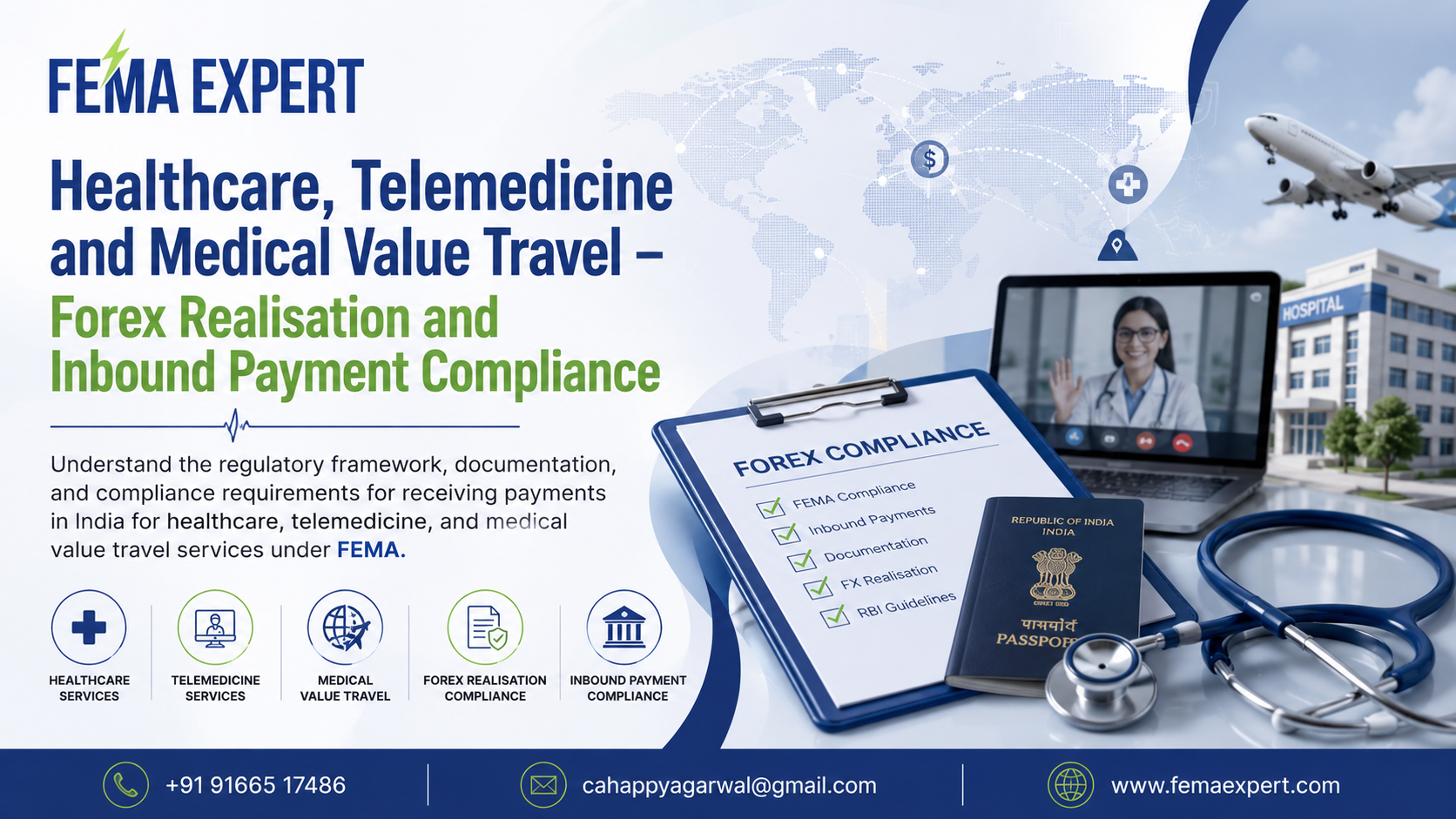
India’s healthcare and telemedicine sector is quietly turning into a serious export engine, bringing in foreign currency from patients and clients across the world. But with every dollar or euro that lands in your bank account, the rules of FEMA, RBI, and forex realisation also come into play.
In the last few years, India has seen a massive rise in cross-border healthcare services. International patients now come to India not just for surgeries, but also for IVF, orthopaedics, cosmetic procedures, Ayurveda, wellness, and long-term rehabilitation. At the same time, telemedicine and online consultations let Indian doctors treat patients sitting in the US, Africa, the Middle East, and beyond.
This shift has created a new kind of challenge for hospitals, clinics, and health-tech startups: how to receive foreign payments smoothly, on time, and in a way that fully complies with FEMA (Foreign Exchange Management Act) and RBI rules.
If forex realisation, FIRC, AD banks, and purpose codes feel confusing, you are not alone. That’s exactly where a specialised FEMA Consultant can help – by turning complex rules into simple, repeatable processes so you don’t lose sleep over inbound remittances.
Under FEMA, healthcare and telemedicine can qualify as export of services when treatment or medical support is provided from India to a patient or client located outside India, and payment is received through permitted channels in foreign currency or eligible INR routes.
In real life, this can include:
It helps to mentally separate three buckets of income:
Once you start earning from the second and third buckets, FEMA and forex realisation rules kick in.
Medical Value Travel (MVT or MTT) is when patients travel to another country for treatment – and India is now one of the world’s top destinations. Patients come for cardiology, IVF, orthopaedics, cosmetic surgery, complex procedures, Ayurveda, and wellness packages at a fraction of Western prices, without compromising on quality.
On the FEMA and forex side, MTT brings its own questions:
If you get the structure right early – clear quotes, formal treatment packages, and proper invoices – forex flows for MTT become much easier to manage.
Telemedicine is now mainstream in India and globally. In simple terms, it is remote diagnosis and treatment using digital communication – video calls, chat, and digital reports.
For cross-border telemedicine, common payment channels include:
To stay FEMA-compliant, you need to focus on a few basics:
If you don’t do this, problems like delayed forex realisation, unreported inward remittances, and mismatches between invoices and bank entries are very common – especially when payment gateways split or batch settlements.
Forex realisation simply means: the foreign exchange you have earned for your healthcare or telemedicine service has actually reached India and been credited to your bank account in line with FEMA rules.
Ignoring these rules can trigger FEMA penalties, closer AD bank scrutiny, delays in future remittances, and formal compliance notices if irregularities are spotted in data-monitoring systems.
Authorised Dealer (AD) Category-I banks are the only banks allowed to handle most export-related foreign exchange transactions in India, including healthcare service exports.
They play four important roles:
Common issues they raise include missing agreements, vague service descriptions (e.g., just “consulting”), incomplete patient documentation, and confusion when multiple foreign sources pay for the same treatment.
Best practices: standardised invoicing, structured patient onboarding forms, detailed treatment documentation, and timely reconciliation of bank credits with your books.
Global Capability Centres (GCCs) are also entering healthcare via remote diagnostics, medical coding, revenue cycle management, patient coordination, and healthcare analytics for overseas hospitals and insurers.
For such GCC-style operations, FEMA questions often relate to:
Read :- Why Your Cross-Border Transaction Failed Without FEMA Compliance?
A clear compliance strategy usually involves well-drafted contracts, defined service scopes, structured remittance workflows, and documentation systems that can stand up in both FEMA and tax audits.
Once healthcare exports scale, simple manual bookkeeping is not enough. You need:
Specialised consulting account services help set up these systems, coordinate with AD banks, and ensure every inward patient payment or telemedicine fee can be backed by clean documentation and reconciled numbers.
For healthcare forex compliance, documents are your safety net. A robust file (physical or digital) usually includes:
These become crucial during FEMA inspections, AD bank reviews, GST audits, or when foreign patients or insurers raise disputes.
Some of the most frequent mistakes seen in this space include:
Most of these can be fixed with clear internal SOPs and periodic reviews by a FEMA-aware advisor.
A FEMA Expert works like your compliance partner for international healthcare revenue. They typically help with:
For healthcare businesses, the benefits are clear: lower compliance risk, faster and smoother remittance processing, stronger audit preparedness, and more confidence to scale internationally without fear of regulatory surprises.
The future looks bright – and more regulated:
Healthcare providers that build strong compliance foundations today will be best placed to ride this wave.
Forex realisation means the foreign currency you earned for healthcare or telemedicine services has been received into India within the timelines and conditions prescribed under FEMA and RBI rules. It is usually evidenced through documents like bank credits, FIRC/e-FIRC, and remittance advice.
Yes, telemedicine consultations provided from India to patients located outside India can qualify as export of services if FEMA and GST conditions are met, including place of supply and receipt of consideration through permitted channels.
Typically you need invoices, treatment or consultation records, foreign remittance proof, FIRC/e-FIRC or IRM details, patient or client agreements, and basic KYC details where relevant.
Your AD Bank processes foreign inward remittances, validates purpose codes, reports transactions to RBI systems like EDPMS, and issues e-FIRCs or equivalent confirmations for export proceeds.
Without proper FEMA compliance, hospitals and facilitators risk penalties, delayed or blocked remittances, and difficulties in proving that foreign income is genuine and fully realised. Good compliance also supports GST refunds and builds trust with overseas partners.
A FEMA Expert can help structure your cross-border healthcare operations, set up documentation and invoicing systems, coordinate with AD banks, clean up past non-compliance, and create smooth, audit-ready processes for future foreign patient and telemedicine payments.