


Authorized Dealer (AD) Banks have moved from being simple forex counters to becoming powerful compliance checkpoints for every cross‑border transaction a business undertakes. In today’s FEMA environment, understanding how AD Banks work—and why their SOPs and approval frameworks differ—is critical for exporters, service providers, and startups that want smooth and timely foreign exchange operations.
India’s foreign exchange regime has evolved significantly since the Foreign Exchange Management Act (FEMA), 1999 replaced the older FERA regime, shifting the focus from strict control to managed facilitation of foreign trade and payments. In this framework, Authorized Dealer Banks form the backbone of RBI’s foreign exchange implementation, acting as the operational arms of policy on the ground.
As regulations have deepened and become more nuanced—especially with new export‑import and EXIM guidelines—Standard Operating Procedures (SOPs) and internal approval systems at AD Banks have grown increasingly complex. This is why specialized guidance from FEMA consultant has become essential, helping businesses interpret rules, prepare documentation, and navigate divergent bank practices while staying fully compliant.
In simple terms, AD full form in banking is Authorised Dealer, and ads full form in banking (commonly searched) refers to the same concept—banks or entities authorised by RBI to deal in foreign exchange under FEMA. An Authorized Dealer Bank is a bank that has been granted specific authorization by the Reserve Bank of India to buy, sell, remit, and otherwise handle foreign currency and foreign securities on behalf of customers.
Read Article :- EDPMS and IDPMS in the New Regime
These AD Banks operate under FEMA, 1999 and Section 10 of the Act, which empowers RBI to authorize persons to deal in foreign exchange. AD Bank meaning, therefore, is not just “a bank that handles forex,” but a regulated intermediary that must enforce FEMA rules, verify transaction purpose, and report transactions to RBI.
Broadly, Authorized Dealers are categorized as:
For most businesses, routing transactions through an AD Category I Bank is mandatory for exports, imports, ODI, ECB, and many other FEMA‑regulated activities.
Over time, AD Banks have shifted from being mere processors of forex deals to acting as compliance gatekeepers for FEMA and RBI guidelines. They are expected to verify the legitimacy, underlying purpose, and documentary support of each transaction, not just its amount and currency.
Their expanded responsibilities include:
In many practical situations, your AD Bank is the first—and sometimes the final—authority that decides whether a particular forex transaction will be permitted in its current form.
Read Article :- From SOFTEX to Unified EDF
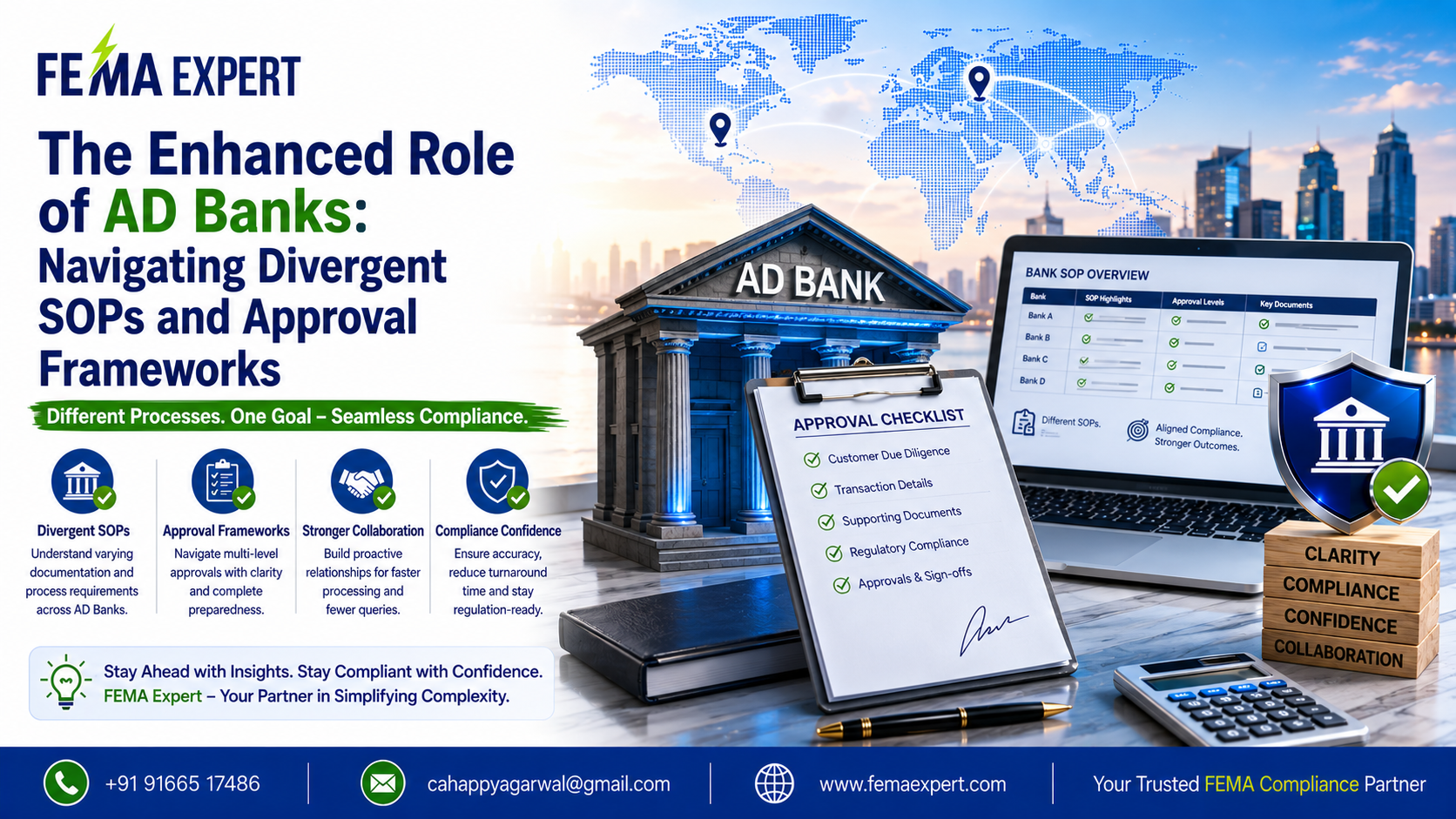
A common pain point for businesses is that AD bank means different things in practice depending on which bank you deal with, because SOPs vary significantly from bank to bank. While the underlying FEMA regulations and RBI directions are common for everyone, each AD Bank builds its own internal policy and SOP based on its risk appetite, systems, and controls.
This leads to visible differences, such as:
Recent EXIM/Export‑Import guidelines explicitly require AD Banks to frame internal SOPs covering documents, timelines, charges, and approval conditions for trade transactions—formalizing what was earlier largely internal practice. This drives more structure but can also increase divergence across banks.
In daily operations, an approval framework inside an AD Bank is the internal route a transaction must travel—from branch to forex desk to compliance—to receive a “go‑ahead.” It converts regulatory permissions and RBI circulars into concrete checks, thresholds, and workflow steps.
Typical areas where approvals are needed include:
Internal compliance teams within the bank review higher‑risk or non‑standard cases, sometimes escalating to centralized committees or even seeking clarification from RBI in complex matters. For the customer, this often appears as “the file is with compliance” or “awaiting HO approval.”
Because SOPs and approval frameworks are not uniform, businesses face several practical challenges:
Exporters, IT/ITES service providers, and startups with global clients feel this acutely, as they rely on timely forex inflows and outflows to keep operations running.
For exporters, AD Category I Banks are the primary channel for receiving export proceeds and reporting them in EDPMS, meaning any delay or hesitation at the bank level directly impacts realization timelines. New EXIM rules still place AD Banks at the center of monitoring realization periods, reductions in invoice value, and closure of export entries.
Service and software exporters, in particular, face challenges like:
For high‑growth startups offering SaaS, consulting, or digital services, these hurdles can translate into delayed funding rounds, slow expansion, and additional compliance costs.
Despite the challenges, businesses can significantly reduce friction by adopting a structured approach:
Treat your AD Bank as a partner in compliance, not just a transaction counter. This mindset shift itself can improve turnaround times and reduce disputes.
Given the evolving regulatory landscape, many businesses now rely on specialized FEMA Expert advisory services to manage complex cross‑border structures and multi‑bank setups. A FEMA Expert helps in:
For organizations with multiple AD relationships—say, one bank for export transactions and another for ODI/ECB—an external FEMA Expert often becomes the central coordination point.
Recent regulatory moves indicate RBI is trying to harmonize and simplify the export‑import and trade framework, while still giving AD Banks operational flexibility. New regulations and EXIM guidelines consolidate earlier circulars, promote uniform reporting formats, and encourage clearer internal policies at the AD level.
Going forward, businesses can expect:
In other words, AD Banks will likely remain powerful compliance authorities, but with slightly more predictable frameworks as RBI keeps refining the system.
To summarize in plain language, AD Bank means a bank that not only handles your foreign exchange but also polices it on behalf of RBI and FEMA. Divergent SOPs and approval processes are a practical reality, not an exception, and businesses must learn to navigate them smartly instead of fighting them.
A strategic approach—solid documentation, clarity on each bank’s SOP, and ongoing engagement with well‑versed FEMA Expert advisory services—can turn AD Banks from perceived bottlenecks into strong partners in your global growth journey.
1. What is AD full form in banking?
AD full form in banking is Authorised Dealer, referring to banks and other entities authorized by RBI to deal in foreign exchange under FEMA.
2. What is ads full form in banking?
“Ads full form in banking” usually points to the same term—Authorised Dealer (AD)—which covers Authorized Dealer banks and other authorized persons like money changers under FEMA.
3. What does AD Bank mean under FEMA?
AD Bank meaning under FEMA is a bank that has obtained RBI authorization to conduct foreign exchange business, implement FEMA rules, verify documents, and report transactions.
4. Why must exporters route transactions through AD Banks?
Exporters are required to route their foreign exchange earnings and related documentation through AD Category I Banks so that realization, documentation, and reporting to EDPMS are properly monitored as per FEMA and RBI foreign exchange regulations.
5. Why do different AD Banks ask for different documents?
While FEMA and RBI rules are common, each AD Bank sets its own internal SOP and risk policy, leading to different documentation checklists, approval levels, and timelines even for similar transactions.
6. How can a FEMA Expert help if my AD Bank is delaying approval?
A FEMA Expert can review the transaction structure, align your documentation to the bank’s internal SOP, communicate with the bank using the right regulatory references, and, where required, guide representations or alternative structures to avoid prolonged delays.