

A garment exporter once paid full customs duty on imported fabric. He didn’t know he could import it duty-free. His raw material cost was eating into his margins, and nobody had told him about a scheme built exactly for his situation.
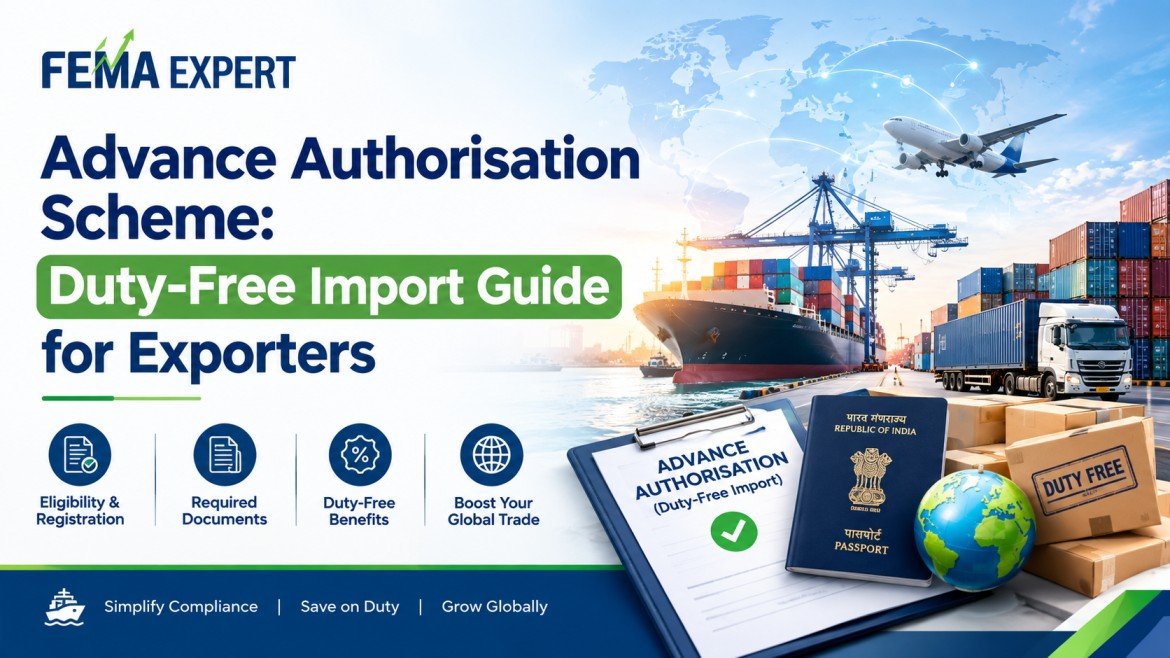
That scheme is called Advance Authorisation. Some businesses still call it by its older name, the advance license scheme. Same scheme, different name over the years.
This guide covers advance authorization scheme basics, eligibility, and how to actually apply.
Advance Authorisation lets exporters import inputs without paying duty. But there’s a condition. Those inputs must actually go into the export product.
This isn’t a blanket exemption. It’s tied to your specific export. You import raw material duty-free, use it to make your product, then export that product. The scheme closes once you complete both sides.
Authorisation isn’t issued randomly. It follows one of four routes.
Most products already have notified norms. These tell you exactly how much input is allowed per unit of export product.
If no SION exists, you can self-declare your input requirement, following the process laid out in the Handbook of Procedures.
For applicant-specific cases, the Norms Committee at DGFT headquarters can fix your input-output ratio directly.
Certain exporters can use this route under the Foreign Trade Policy, avoiding the norms fixation process altogether.
Two types of exporters can apply.
Both routes work. What matters is having a genuine export commitment behind the application.
This is where the real savings come in. Imports under this scheme skip several duties at once.
That’s a meaningful cost reduction compared to paying full duty and hoping for a refund later.
You can’t just import and re-export with no real work done. The scheme requires 15% minimum value addition.
The formula looks like this:
Value Addition = (FOB Value − CIF Value) ÷ CIF Value × 100
Your export value has to genuinely exceed your import cost by this margin.
Submit your application online, digitally signed, to your jurisdictional Regional Authority. Your registered office, head office, branch, or manufacturing unit can all apply.
Attach all required documents during the online filing itself. No physical copies need to go anywhere.
If your product has no notified SION, file ANF 4B separately with the concerned Norms Committee before your main application moves forward.
Once approved, you get your authorisation, and duty-free imports can begin against it.
Not everyone gets the same import ceiling.
Your authorisation is valid for 12 months from the date of issue, for standard import purposes.
If you need more time, one revalidation of 12 months is allowed. After that, no further revalidation happens. Apply for this online through your Regional Authority, before your original validity runs out.
You get 18 months from the date of issue to complete your export obligation. This clock starts running immediately, unless the authorisation says otherwise.
If you need more time, extensions are possible, but they come with a composition fee attached. A first six-month extension is available, and a second six-month extension can follow after that. Beyond these two, no further extension is granted, and total extensions can’t exceed 12 months past your original EO deadline.
You’re required to track exactly how much duty-free input you’ve consumed against each authorisation. This record needs verification, either by Customs, or jointly by a Chartered Engineer and Chartered Accountant.
Keep these records for at least three years from the date your Export Obligation Discharge Certificate is issued. You’ll need this documentation when you eventually apply for redemption.
Once your export obligation period ends, you have six months to file your application online, linking your shipping bills to the authorisation. Miss this, and the Regional Authority can initiate action under the Foreign Trade Act.
If you’ve completed your obligation properly, the Regional Authority issues your EODC, or Export Obligation Discharge Certificate, closing out the authorisation.
At FEMA Expert, we help exporters work through Advance Authorisation applications, norms fixation, and export obligation compliance, so duty savings don’t get lost in avoidable paperwork gaps.
Since Advance Authorisation compliance often overlaps with broader cross-border transactions, our team also supports related FEMA advisory needs, including matters handled by our FDI consultant in India team for foreign investment compliance.
Need help applying for Advance Authorisation? Reach out to FEMA Expert today.
The Advance Authorisation Scheme gives exporters a genuine cost advantage on imported inputs, but the compliance around value addition, export obligation timelines, and account maintenance needs careful tracking. Missing a deadline can turn a duty-free benefit into a compliance headache.
If you’re applying for Advance Authorisation or managing an existing one, FEMA Expert’s team can guide you through the process.
1. What is the Advance Authorisation Scheme?
It’s a DGFT scheme that allows exporters to import inputs duty-free, provided those inputs are used in making the export product.
2. Is Advance Authorisation the same as the advance license for export?
Yes, this is the older name for the same scheme. The underlying benefit and process remain similar.
3. Who can apply for Advance Authorisation?
A manufacturer exporter, or a merchant exporter tied to a supporting manufacturer, can both apply.
4. What is the minimum value addition required?
15%, calculated as the difference between FOB and CIF value, divided by CIF value, multiplied by 100.
5. How long is Advance Authorisation valid for imports?
12 months from the date of issue, with one possible revalidation of another 12 months.
6. What is the export obligation period under this scheme?
18 months from the date of issue, with extensions available subject to a composition fee.
7. What happens if I don’t complete my export obligation on time?
You can apply for extensions up to a combined 12 months beyond the original deadline. Beyond that, the Regional Authority can initiate action under the Foreign Trade Act.
8. How can FEMA Expert help with Advance Authorisation?
We assist with eligibility checks, application filing, norms fixation, and export obligation compliance, alongside broader FEMA and FDI advisory support.