


A manufacturer once told us he was paying full customs duty on every machine he imported. His competitor, doing the exact same business, wasn’t paying that duty at all. The difference was one registration he’d never applied for.
That registration is called EOU. It’s built specifically for businesses that export most of what they make.
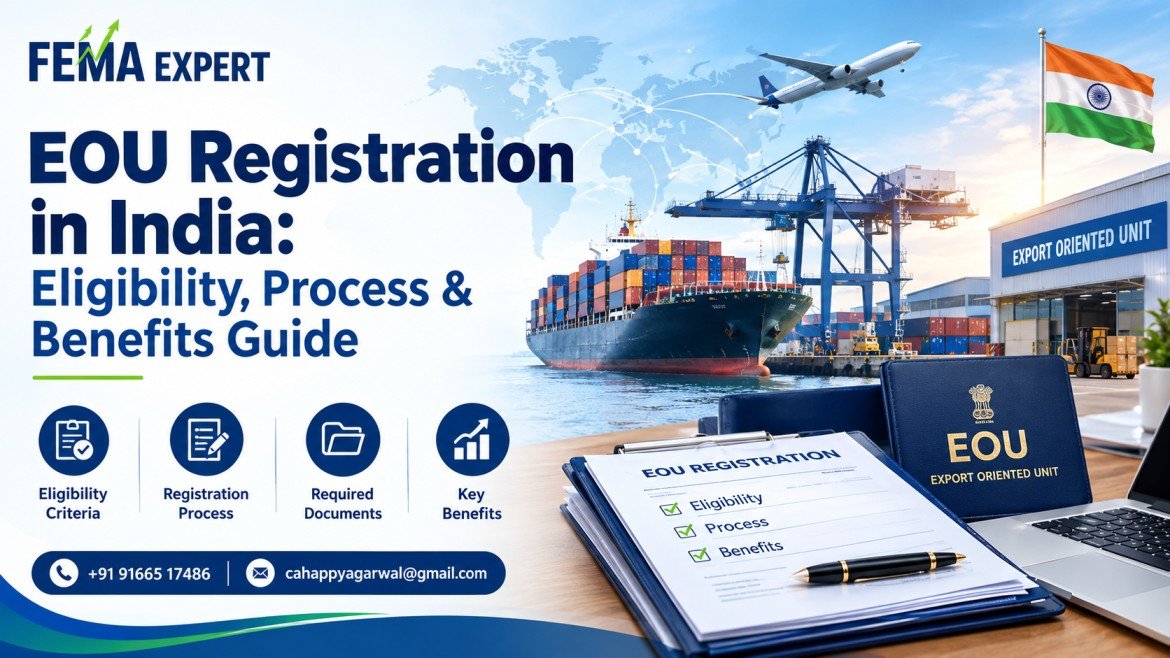
This guide covers what EOU meaning who qualifies, and how to register.
EOU full form in customs is Export-Oriented Unit. It’s a business set up mainly to manufacture goods or provide services for export.
The EOU scheme lets these units import machinery and raw materials without paying full customs duty. In return, the unit commits to exporting a large share of what it produces.
You’ll also come across EOU full form in GST discussions, since EOUs get specific GST treatment tied to their export focus, separate from how regular domestic manufacturers are taxed.
The government wanted more export-focused manufacturing in India. But high import duty on machinery made it expensive to set up.
The EOU scheme fixed that gap. It lowered upfront costs for exporters. It also aimed to bring in foreign investment, create jobs, and boost India’s overall export numbers.
Most units need Rs. 1 crore invested in plant and machinery. Some sectors are exempt from this, including software, biotechnology, and handicrafts.
The unit must achieve positive Net Foreign Exchange over a 5-year block. Simply put, foreign exchange earned through exports must exceed what’s spent on imports during that period.
Pure trading companies don’t qualify. The unit must actually manufacture, process, or provide an eligible service. Buying and reselling goods without any processing doesn’t meet the EOU scheme’s requirements.
Register your business first, as a company, LLP, partnership, or proprietorship. Then obtain your Import Export Code from DGFT. This is mandatory before applying.
Put together a report covering your product, capacity, target market, and investment plan. This backs up your application.
Submit this application with all supporting documents to the Development Commissioner or Board of Approval, depending on your case.
The committee checks your project’s feasibility and confirms it meets EOU scheme conditions.
Once approved, you get your LOP. This is generally valid for two years to set up your unit and install machinery.
After the LOP, you’ll need to execute an LUT, submit a B-17 Bond, get your Green Card, and complete ICEGATE registration. Only then can operations actually begin.
EOU approval generally runs for five years. It stays valid as long as you keep meeting the scheme’s compliance and performance conditions.
| Basis | EOU | SEZ |
| Location | Can be set up anywhere, not restricted to a zone | Must be located within a notified SEZ area |
| Approval authority | Development Commissioner / Board of Approval | SEZ Authority |
| Flexibility | More location flexibility for businesses | Tied to specific zone infrastructure |
| DTA sales | Allowed, within specified limits | Allowed, subject to SEZ-specific rules |
EOUs aren’t limited to exports alone. They can sell a specified portion of their production in the Domestic Tariff Area, subject to applicable duties and conditions. This gives businesses some flexibility to also serve the local market alongside their export commitments.
At FEMA Expert, we help exporters navigate EOU registration, from eligibility checks to post-approval compliance like LUT and ICEGATE registration.
Since EOU businesses often deal with foreign investment or cross-border transactions too, our broader FEMA advisory team, including our FDI consultant in India services, can support that side of your compliance as well.
Planning to set up an EOU? Reach out to FEMA Expert to get started.
The EOU scheme gives export-focused businesses real cost advantages, but only if the eligibility, documentation, and post-approval steps are handled correctly. Missing even one compliance step can hold up your unit’s approval or operations.
If you’re planning to register an EOU, FEMA Expert’s team can guide you through the entire process.
1. What is an Export-Oriented Unit (EOU)?
It’s a business mainly for export-focused manufacturing or services. It’s registered under a government scheme that gives customs duty exemptions.
2. What is the EOU full form in customs?
Export-Oriented Unit. It refers to a unit approved under this scheme to import goods with customs duty benefits, tied to export commitments.
3. Is IEC mandatory for EOU registration? Yes, an Import Export Code from DGFT is mandatory before applying for EOU registration.
4. What is the least investment needed for an EOU?
Generally Rs. 1 crore in plant and machinery, though certain sectors like software and biotechnology are exempt.
5. Can an EOU sell products in the domestic market?
Yes, EOUs can sell a specified part of their output in the Domestic Tariff Area, subject to applicable duties.
6. What is the difference between EOU and SEZ?
You can set up EOUs anywhere, and they aren’t tied to a specific zone, while SEZ units must operate within a notified SEZ area.
7. How long is EOU approval valid?
Generally five years, as long as the unit continues to meet scheme conditions and performance requirements.
8. How can FEMA Expert help with EOU registration?
We assist in checking eligibility, preparing documents, and filing Form ANF-6A. We also take care of post-approval compliance, which includes filing a LUT and registering on ICEGATE.