



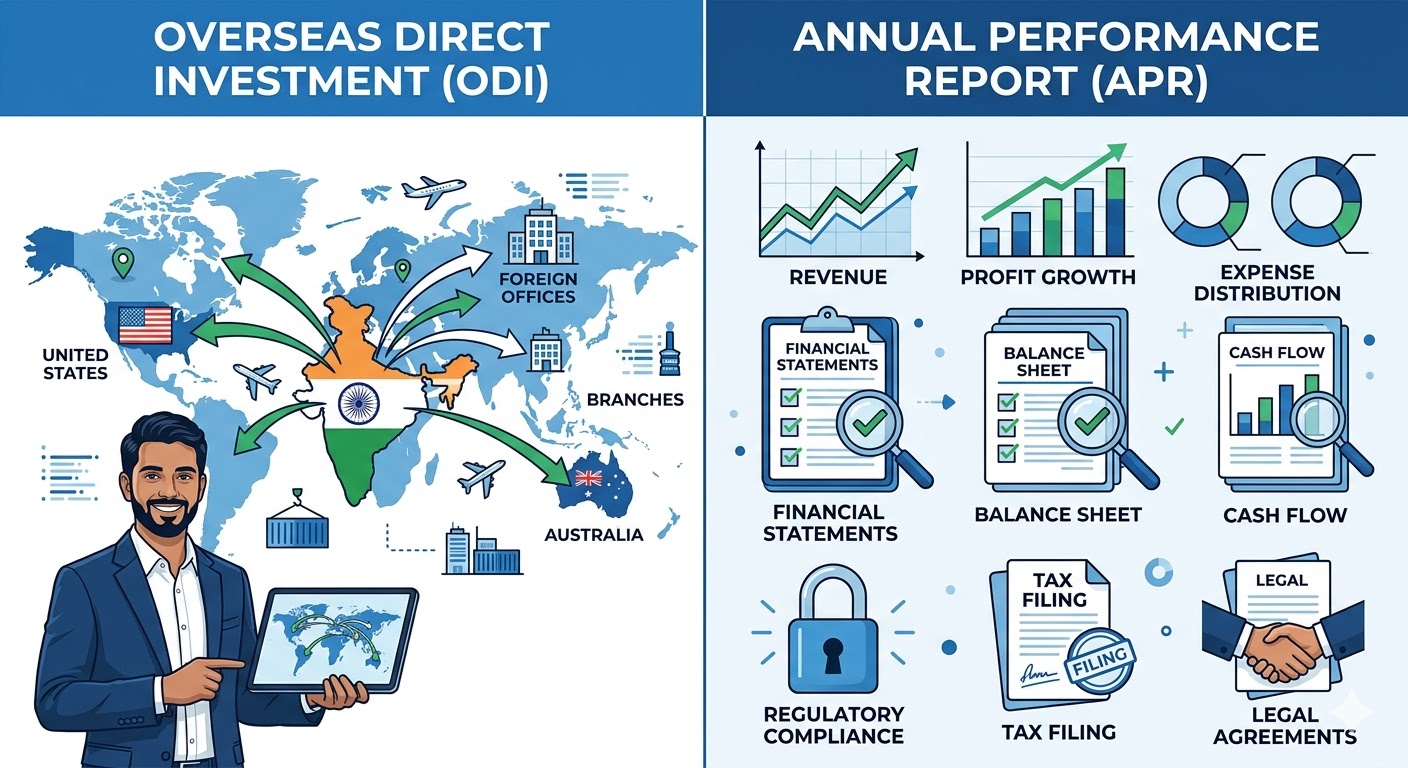
Expanding globally is no longer limited to large corporations Indian startups and SMEs are actively investing abroad. However, with opportunity comes compliance. Two critical aspects of foreign investment regulations are Overseas Direct Investment (ODI) and Annual Performance Reports (APR).
Understanding the difference between ODI and APR is essential for businesses to avoid penalties and ensure smooth international operations.
Overseas Direct Investment (ODI) refers to investments made by Indian entities in foreign companies, while Annual Performance Report (APR) is a mandatory yearly filing that reports the financial performance of those overseas investments under FEMA regulations.
| Basis | ODI | APR |
|---|---|---|
| Purpose | Investment abroad | Annual reporting |
| Frequency | One-time | Yearly |
| Authority | RBI | RBI |
| Compliance | Initial filing | Ongoing filing |
Overseas Direct Investment (ODI) refers to investments made by Indian entities in foreign companies, either through equity participation, joint ventures, or wholly owned subsidiaries. ODI allows businesses to expand globally and tap into new markets.
APR is a mandatory yearly filing that tracks the financial performance of overseas investments made under ODI. It ensures that Indian authorities monitor the health and compliance status of foreign entities.
Many businesses assume ODI compliance ends after investment. In reality, APR ensures ongoing monitoring. Missing APR filings can lead to serious compliance issues under Foreign Exchange Management Act.
All ODI and APR compliances are governed by the Reserve Bank of India. RBI provides detailed rules regarding investment limits, reporting formats, and timelines.
The Foreign Exchange Management Act (FEMA) regulates cross-border transactions. ODI approvals, reporting, and APR filings must strictly adhere to FEMA provisions.
Failure to comply can lead to penalties, restrictions on further investments, and scrutiny from regulators.
APR must be filed annually, typically before the year-end deadline set by RBI.
Errors can be corrected by revising the filing through the same authorized channel.
Late or non-filing may result in financial penalties and restrictions on future ODI transactions.
An Indian company investing in a Singapore-based subsidiary must file ODI at the time of investment and obtain a UIN.
Each year, the company must report profits, losses, and net worth through APR to ensure transparency.
ODI enables investment, while APR ensures continued compliance. Ignoring either can create regulatory issues.
ODI starts the process; APR sustains compliance throughout the investment lifecycle.
Proper compliance builds credibility and enables smoother global expansion.
Working with experts like FEMA Expert helps businesses handle complex filings, avoid penalties, and stay compliant with evolving regulations.
For businesses dealing with foreign investments and share transfers, understanding compliance doesn’t stop at ODI and APR. You should also read:
👉 Reporting Share Transfers Under FEMA: Form FC-TRS Explained
This helps you understand how share transfers involving non-residents are reported an essential part of FEMA compliance.
Yes, APR filing is mandatory for all active overseas investments.
Non-filing can lead to penalties and restrictions under FEMA.
No, ongoing APR compliance is required after ODI.
Errors can be revised through authorized dealer banks with proper documentation.
For Indian businesses expanding globally, understanding ODI vs APR is not optional it’s critical. With the right strategy and expert guidance, compliance becomes a smooth process rather than a burden.