

An NRI client once asked us why his rent income got stuck. He had it credited to his NRE account. That’s not allowed. NRE accounts don’t accept Indian-sourced income.
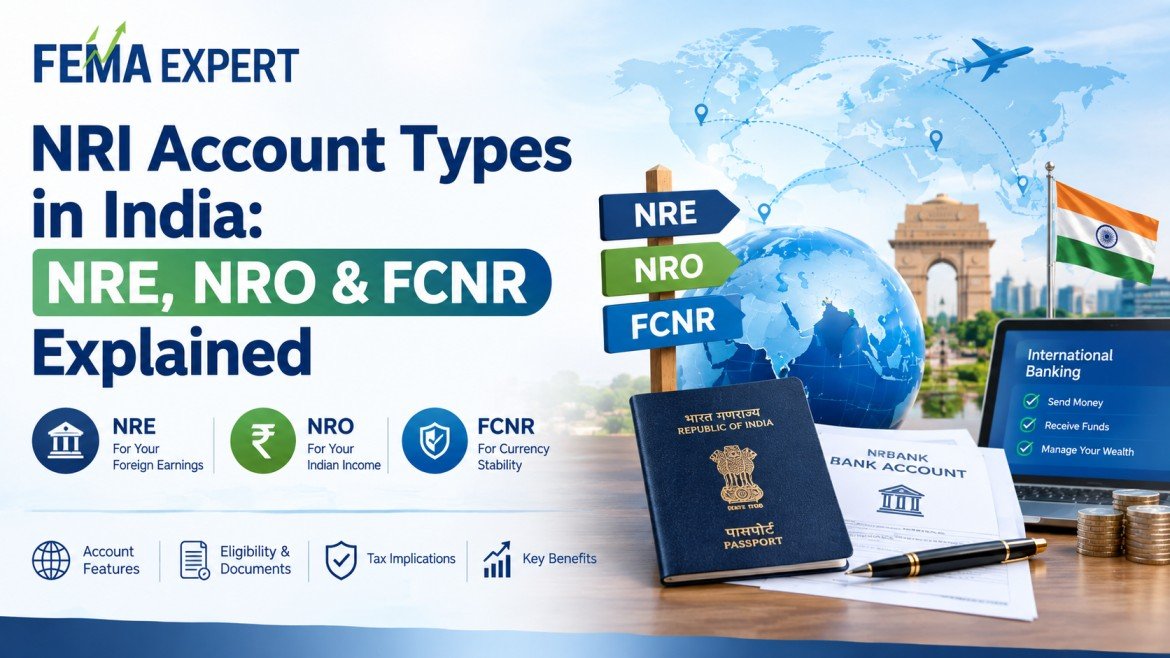
This confusion is common. Many NRIs don’t know which account suits which purpose. This guide covers NRI account types, and which one fits your situation.
An NRI account is a bank account designed specifically for Non-Resident Indians. It lets you manage money earned in India, and money earned abroad, separately.
These accounts follow FEMA rules. Regular resident savings accounts don’t work the same way once you become an NRI. You need to switch.
This account holds income earned outside India. Deposits happen in foreign currency. The bank converts it to rupees.
This account holds income earned within India. Rent, dividends, and pension fall here. It manages your Indian-sourced money.
This is a term deposit account. Money stays in foreign currency. No conversion happens. Exchange rate risk stays off the table.
| Basis | NRE | NRO | FCNR |
|---|---|---|---|
| Source of funds | Foreign income | Indian income | Foreign income |
| Currency held | Indian Rupees | Indian Rupees | Foreign currency |
| Repatriation | Fully repatriable | Limited repatriation | Fully repatriable |
| Taxation | Tax-free in India | Taxable in India | Tax-free in India |
| Account type | Savings/Current | Savings/Current | Fixed Deposit only |
NRE and FCNR accounts allow full repatriation. You can move the entire balance abroad, anytime.
NRO accounts work differently. Repatriation is capped. Currently, up to USD 1 million per financial year is allowed, subject to tax clearance and proper documentation.
NRE and FCNR account interest stays tax-free in India. NRO account interest gets taxed. TDS applies before you even see the money.
This is exactly why choosing the right account matters. Put foreign income in NRO by mistake, and you lose tax-free status unnecessarily.
Yes. Once your residency status changes, existing resident accounts must convert to NRO. This isn’t optional. FEMA requires it.
Banks handle this conversion once you inform them of your NRI status. Skipping this step technically violates FEMA regulations.
The Liberalised Remittance Scheme applies to resident Indians, not NRIs directly. But NRIs still interact with LRS indirectly, especially when moving money between accounts or helping family members remit funds.
Understanding both LRS and your NRI account type helps you avoid compliance issues on either side.
At FEMA Expert, we help NRIs choose the right account structure, and stay compliant with FEMA rules around repatriation and taxation.
Our broader FEMA advisory team, including our RBI and LRS remittance consultant services, supports NRIs managing cross-border money movement, so your accounts and your compliance stay aligned.
Need help setting up or managing your NRI accounts? Reach out to FEMA Expert today
Choosing the right NRI account protects your money and your compliance. NRE, NRO, and FCNR each serve a different purpose. Getting this right from the start saves you confusion later.
If you need help setting up your NRI accounts correctly, FEMA Expert’s team can guide you.
1. What is the difference between NRE and NRO accounts?
NRE holds foreign income and is fully repatriable, while NRO holds Indian income with limited, capped repatriation.
2. Is NRE account interest taxable in India?
No, interest earned on NRE and FCNR accounts stays tax-free in India.
3. Can I open an FCNR account in any currency?
Banks typically offer FCNR accounts in select major currencies like USD, GBP, and EUR, depending on the bank.
4. Do I need to convert my resident account after becoming an NRI?
Yes, FEMA requires resident accounts to be converted to NRO once your residency status changes.
5. How much can I repatriate from an NRO account?
Up to USD 1 million per financial year, subject to tax clearance and documentation.
6. Which account should I use for rental income in India?
NRO account, since it’s meant to hold income earned within India.
7. Is TDS applicable on NRO account interest?
Yes, TDS is deducted on NRO account interest before you receive it.
8. How can FEMA Expert help with NRI account compliance?
We help NRIs choose the right account type and stay compliant with FEMA rules on taxation and repatriation.