

A supplier we spoke with had been charging GST on every shipment to his SEZ customer for over a year. He didn’t know he could skip that tax entirely. His SEZ customer knew, but nobody had told the supplier how the process actually worked.
This gap is common. SEZ in GST comes with real tax benefits, but the rules around claiming them confuse a lot of businesses on both sides of the transaction.
This guide covers what SEZ is in GST, how supplies to SEZ actually work, and where most of the confusion comes from.
A Special Economic Zone is a specific area in India. It aims to boost business and exports. Units operating here get special treatment under tax law, meant to encourage growth in these zones.
SEZ full form in GST context refers to this same designation, Special Economic Zone, and GST law treats it quite differently from a regular business location.
Here’s the part that surprises most people. Even though an SEZ unit in GST sits physically within India, GST law treats it as if it were outside the country.
Any supply of goods or services to or from an SEZ is treated as an inter-state supply. This holds true even when both the supplier and the SEZ unit are in the same state. Trade between two SEZ units is treated the same way.
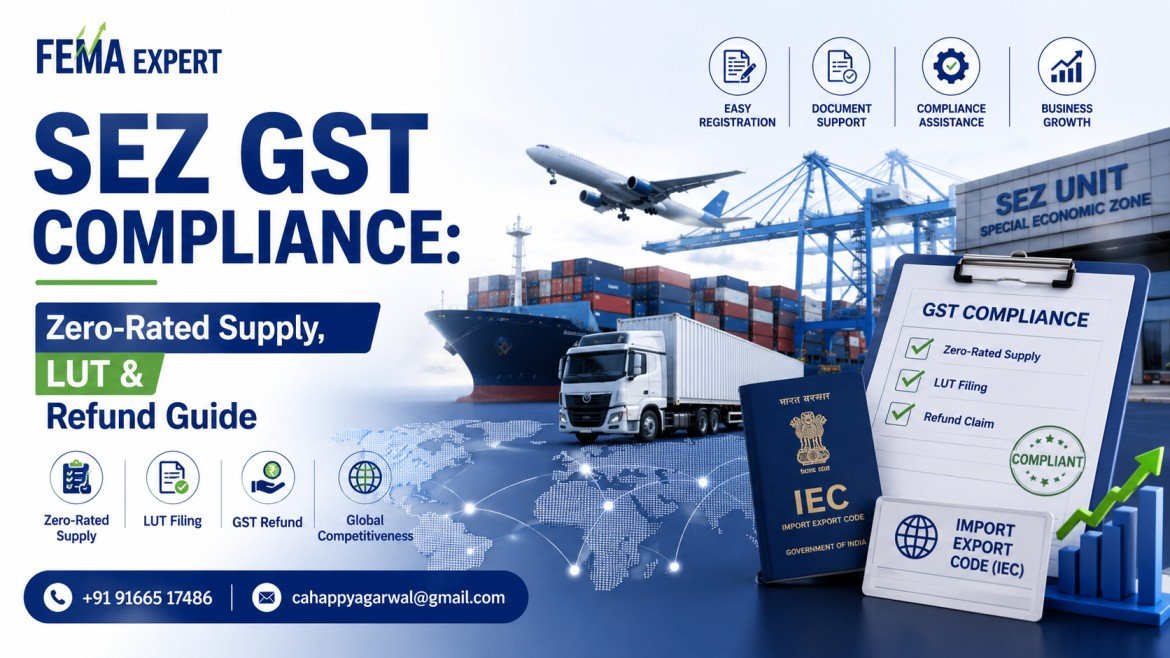
Supply to SEZ under GST is classified as a zero-rated supply. This means no GST is charged on it, similar to how exports are treated.
On the flip side, if an SEZ unit supplies goods to a Domestic Tariff Area (regular Indian territory outside SEZ), that’s treated as an import by the DTA, and customs duty applies.
Suppliers to SEZ have two options.
With LUT: The supplier issues a Letter of Undertaking, which means no GST needs to be collected on the supply at all.
Without LUT: The supplier charges IGST upfront. The SEZ unit or developer then has to separately claim that amount back as a refund.
Many suppliers skip filing an LUT, which forces their SEZ customers into a longer refund process and ties up their working capital in the meantime.
When IGST is charged without an LUT in place, the SEZ unit ends up carrying that cost temporarily. Say an SEZ unit buys goods worth Rs. 1,00,000 and pays 18% IGST, that’s Rs. 18,000 sitting with the tax department until a refund is processed.
This is exactly why LUT matters so much here. Skipping it doesn’t just add paperwork, it locks up real money for weeks or longer.
Zero-rating only applies to authorised operations within the SEZ. That part is fairly settled law.
The confusion starts with everything else. Services like banquet arrangements, event management, or accommodation for SEZ employees fall outside what’s considered an authorised operation. A 2018 circular clarified that IGST applies to these, but many suppliers still aren’t sure whether to charge tax or not on such services.
This scenario trips up a lot of suppliers. Picture an SEZ head office instructing a supplier to ship goods directly to a factory located outside the SEZ, in a regular DTA location.
Since the bill is raised to the SEZ entity, the supply should technically qualify as zero-rated. But since the goods physically move to a DTA location, there’s genuine confusion about whether IGST should be charged instead. This particular grey area still doesn’t have a clear, settled answer.
When an SEZ unit sells to a DTA buyer, this is treated as an import into India from the DTA’s side. Customs duty becomes payable by whoever is receiving the supply, not the SEZ unit making it.
One recurring issue: some SEZ developers register themselves as regular taxpayers instead of specifically as SEZ taxpayers. This mistake means they miss out on benefits they’d otherwise be entitled to.
If this happens, the fix involves emailing the GST department at their designated SEZ correction address, along with a scanned copy of the Letter of Approval, to get the registration type corrected.
Certain services, like GTA services, legal services, and sponsorship services, fall under reverse charge, where the recipient pays GST instead of the supplier.
Since supplies to SEZ are otherwise zero-rated, there’s ongoing confusion about whether RCM still applies when an SEZ unit is the recipient of such services.
At FEMA Expert, we help businesses navigate the grey areas around SEZ supply, LUT filing, and GST treatment, so working capital doesn’t get stuck in avoidable refund cycles.
Many of our SEZ and export clients also work with foreign investors or file overseas investment paperwork like ODI forms. If your business needs support there too, or you’re looking for one of the best FDI consultants in India to handle inbound investment compliance, our broader FEMA advisory team can step in alongside your SEZ and EXIM compliance.
Confused about SEZ GST treatment on a specific transaction? Reach out to FEMA Expert for clarity.
SEZ units get real tax advantages under GST, but the rules around zero-rating, LUT filing, and specific transaction types still leave room for confusion. Getting these calls right protects your working capital and keeps your compliance clean on both sides of the supply.
If you’re unsure how GST applies to a specific SEZ transaction, FEMA Expert’s team can help you work through it.
1. What is SEZ in GST?
A Special Economic Zone is seen as outside India for GST, even though it’s still in the country. Supplies to it are also zero-rated.
2. What is the full form of SEZ in GST?
Special Economic Zone. It’s a designated business zone that receives special tax treatment under GST law.
3. Is GST charged on supply to SEZ?
No, supply to SEZ is treated as zero-rated. Suppliers can avoid charging GST entirely by filing an LUT.
4. What happens if a supplier doesn’t file LUT for SEZ supply?
They must charge IGST upfront, and the SEZ unit then has to separately claim a refund, which can tie up working capital.
5. Is trade between two SEZ units taxable?
It’s still treated as an inter-state supply and classified as zero-rated, similar to any other SEZ supply.
6. Does GST apply to non-authorised operations within an SEZ?
Yes, services like employee accommodation or event management aren’t considered authorised operations and typically attract IGST.
7. What if an SEZ developer registered under the wrong GST category?
They can request a correction from the GST department by submitting their Letter of Approval to the designated SEZ correction email.
8. How can FEMA Expert help with SEZ and EXIM GST compliance?
We help identify the correct GST treatment for SEZ transactions, support LUT filing, and coordinate this alongside broader FEMA and FDI compliance needs.