

A trader we spoke with was buying goods for export and paying full GST on every purchase. His margins were thin. He didn’t know a scheme existed that could cut his tax cost down to almost nothing.
That scheme is called merchant export. It’s built specifically for traders like him, people who export goods without manufacturing them.
This guide covers what is merchant exporter, the merchant export GST rate, and how the whole process actually works.
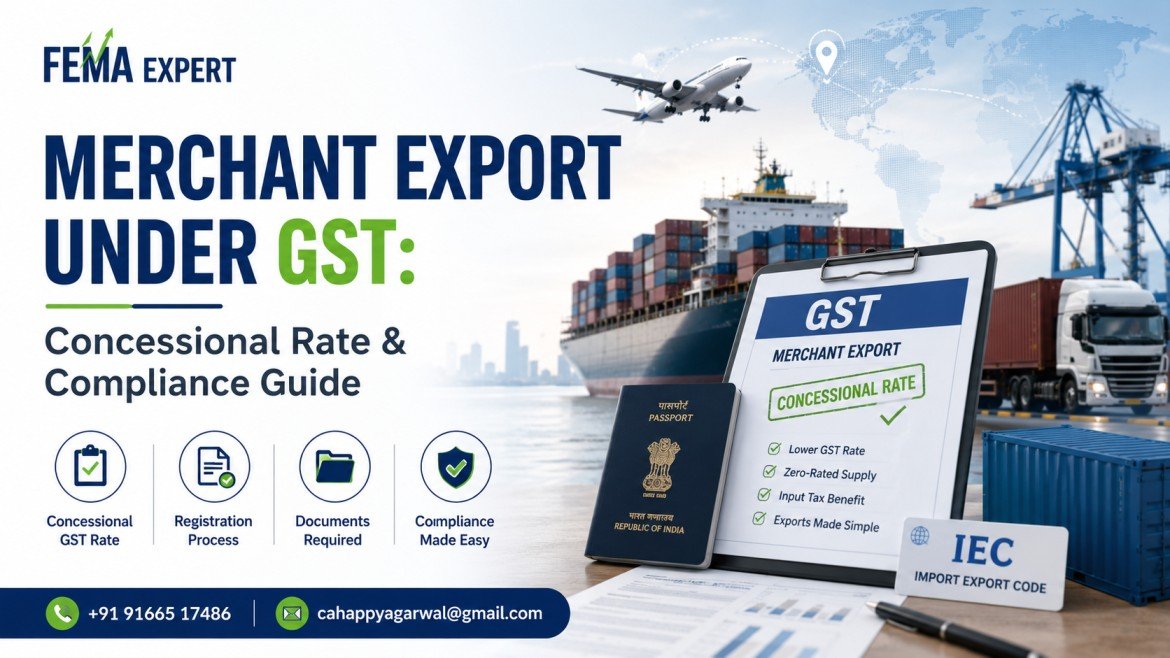
Merchant export lets a trader buy goods at a sharply reduced GST rate, purely for the purpose of exporting them. You pay a lower tax right at the buy. This way, you don’t have to wait for a refund later.
This idea came from a government notice in October 2017. The intention was to help export-focused traders by easing their working capital pressures.
Merchant exporter meaning, in simple terms, is a trader who buys finished goods from a manufacturer or supplier and exports them, without manufacturing anything themselves.
Unlike a manufacturer-exporter, a merchant exporter doesn’t run a factory. Their business is sourcing and shipping, not production.
Here’s the core benefit. The GST rate for merchant exporters on eligible purchases is only 0.1%. This can be either 0.1% IGST or split into 0.05% CGST and 0.05% SGST, depending on the transaction type.
Compare that to the export GST rate a supplier would normally charge on domestic sales, and the difference is significant. This concessional rate exists specifically to stop working capital from getting locked up in tax that would otherwise sit with the government until refunded.
The reduced rate doesn’t apply automatically. A few conditions need to be met.
Both the supplier and the merchant exporter must be registered under GST, and the supply must be made against a proper tax invoice.
The merchant exporter must actually export the goods within 90 days from the date of the supplier’s invoice. Miss this window, and the supplier loses eligibility for the concessional rate.
The Shipping Bill or Bill of Export must carry the supplier’s GSTIN and their tax invoice number, tying the export directly back to the concessional purchase.
The merchant exporter needs to be registered with an Export Promotion Council or Commodity Board recognised by the Department of Commerce.
Goods must move directly from the supplier’s location to the port, airport, or land customs station, or alternatively to a registered warehouse before final export. If routed through a warehouse, the merchant exporter needs to endorse receipt on the invoice and share proof with both the supplier and the tax officer.
Merchant exporters can claim Input Tax Credit on the concessional tax they’ve paid, whether that’s 0.05% or 0.1%.
One important rule here: merchant exporters can only export under LUT or bond. Exporting on payment of IGST isn’t permitted under this scheme.
The supplier who sold goods at the concessional rate can claim a refund themselves, under the inverted tax structure provisions of the CGST Act, since their input tax is often higher than the concessional output tax they charged.
Merchant exporters follow a specific refund route for the accumulated ITC on their concessional purchases.
Reporting works differently for each party involved.
The registered supplier reports this supply under B2B Supplies while filing GSTR-1. It’s important to note this isn’t disclosed as an export on the supplier’s side, since the supplier isn’t the one physically exporting the goods.
The merchant exporter, on the other hand, discloses it under “Export without payment of GST” in their own GSTR-1.
This distinction matters. Since exports under GST are considered as zero-rated supplies, but here it’s the merchant exporter, not the original supplier, who reports the actual export.
At FEMA Expert, we help merchant exporters navigate the concessional GST rate, documentation, and refund process without losing eligibility over a missed condition or deadline.
Since many merchant exporters also deal with SEZ suppliers or overseas investment structures, our team also supports broader SEZ GST advisory, along with FEMA compliance for businesses handling foreign investment or filing ODI forms for outbound investment.
Need help setting up your merchant export compliance correctly? Reach out to FEMA Expert today.
The merchant export scheme gives traders a real cost advantage, but only if the conditions around timelines, documentation, and reporting are followed carefully. One missed deadline or wrong form category can mean losing out on the benefit entirely.
If you’re setting up merchant export compliance or need help with a refund claim, FEMA Expert’s team can guide you through the process.
1. What is merchant exporter in GST?
A merchant exporter is a trader who buys finished goods from a manufacturer or supplier and exports them, without manufacturing the goods themselves.
2. What is the merchant export GST rate?
It’s a concessional rate of 0.1%, either as IGST or split as 0.05% CGST plus 0.05% SGST, subject to specific conditions being met.
3. What is the GST on export of goods normally?
Regular exports are treated as zero-rated supplies, meaning no GST is charged if exported under LUT, or IGST is charged and later refunded if exported on payment of tax.
4. How are exports under GST treated?
Exports under GST are considered as zero-rated supplies, allowing exporters to either export without paying tax under LUT or claim a refund of tax paid.
5. What is the time limit to export goods under the merchant export scheme?
The merchant exporter must export the goods within 90 days from the date of the supplier’s tax invoice.
6. Can a merchant exporter pay IGST instead of using LUT?
No, merchant exporters are required to export only under LUT or bond, not on payment of IGST.
7. Who claims the refund under the merchant export scheme?
Both parties can claim refunds separately, the supplier under inverted duty structure provisions, and the merchant exporter for accumulated ITC on their concessional purchase.
8. How can FEMA Expert help with merchant export compliance?
We help merchant exporters meet the scheme’s conditions, manage documentation, and handle refund filing correctly, alongside related SEZ and FEMA compliance support.