



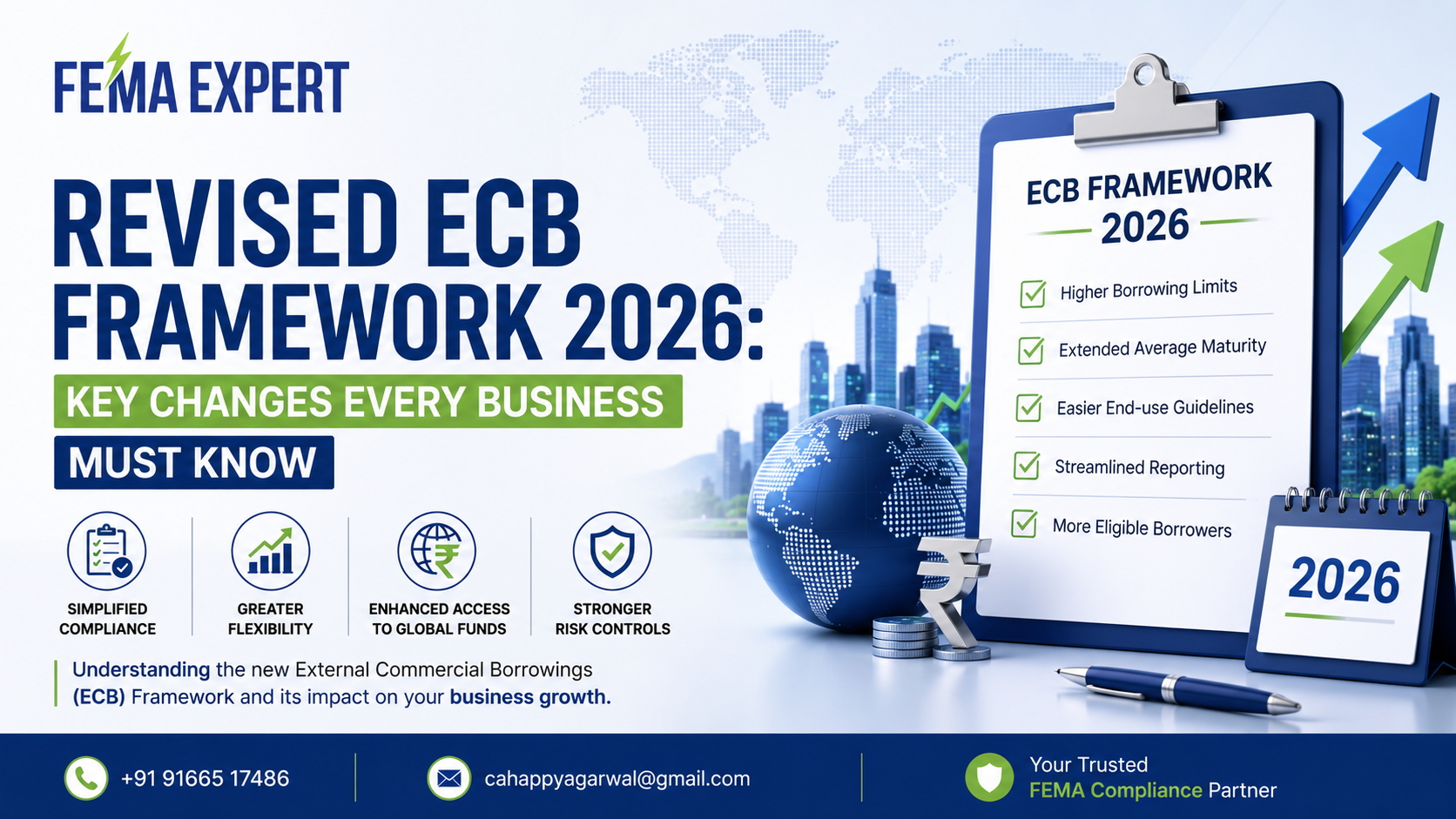
The Reserve Bank of India (RBI) has introduced major updates to the RBI ECB Framework 2026 to make foreign borrowing more flexible and business-friendly. These changes aim to help Indian companies access international funding more easily while maintaining proper regulatory oversight. The revised framework includes higher borrowing limits, expanded lender eligibility, simplified compliance requirements, and greater flexibility in fund utilization. Understanding these changes is important for businesses looking to raise capital from overseas markets.
External Commercial Borrowing (ECB) is a type of loan that eligible Indian entities can obtain from foreign lenders. ECB helps businesses raise funds for expansion, infrastructure development, acquisitions, technology upgrades, and other approved purposes.
ECB is important because it provides access to global capital markets and often offers competitive borrowing costs compared to domestic financing options. It also helps businesses diversify their funding sources and support long-term growth plans.
External Commercial Borrowing (ECB) refers to commercial loans raised by Indian entities from recognized foreign lenders. These borrowings may be denominated in foreign currency or Indian Rupees and are regulated by the Reserve Bank of India under FEMA guidelines.
Common forms of ECB include:
ECB serves as an important source of international financing for Indian businesses.
The revised ECB Framework 2026 introduces several reforms designed to simplify borrowing regulations and increase access to foreign funding.
Key highlights include:
These reforms are expected to support investment, business growth, and economic development.
The revised framework allows a broader range of entities to access External Commercial Borrowing.
Eligible borrowers include:
The inclusion of LLPs is one of the most significant changes introduced under the ECB Rules 2026.
The RBI has expanded the list of recognized lenders to improve funding accessibility.
Eligible lenders include:
This wider lender base creates more opportunities for Indian businesses to secure overseas financing.
One of the most important changes under the ECB Framework Changes 2026 is the increase in borrowing limits.
Under the revised framework:
The increased limit helps businesses undertake large-scale expansion and infrastructure projects.
The RBI has simplified the Minimum Average Maturity Period (MAMP) requirements.
Key changes include:
This change reduces complexity and makes the borrowing process easier to manage.
The revised framework offers greater flexibility regarding currency conversion.
Borrowers can:
This flexibility helps businesses optimize their financing strategy and reduce currency-related risks.
The revised framework relaxes certain restrictions on the use of ECB funds.
Funds may now be used for:
The updated end-use rules provide businesses with more freedom in utilizing borrowed funds effectively.
Yes. One of the significant changes under the Revised ECB Regulations 2026 is the expanded scope for using ECB funds in acquisitions and mergers.
Businesses can now use ECB funds for:
This change supports business growth and encourages investment opportunities.
The RBI has removed certain restrictions related to the all-in-cost ceiling.
This means:
The removal of the cap provides greater market-driven flexibility while allowing borrowers to explore diverse financing options.
The revised framework also simplifies ECB refinancing regulations.
Key benefits include:
Refinancing can help businesses optimize their debt structure and improve financial efficiency.
The updated framework offers several advantages for businesses.
Major benefits include:
These changes make international financing more attractive and accessible for Indian businesses.
The RBI ECB Framework 2026 is expected to have a positive impact on Indian businesses.
Potential benefits include:
Businesses seeking international growth opportunities can benefit significantly from the revised framework.
Despite the relaxed regulations, compliance remains an important aspect of ECB transactions.
Borrowers must:
Many businesses choose to work with a FEMA Consultant in India to ensure accurate compliance and avoid regulatory issues.
| Particulars | Previous Rules | ECB Framework 2026 |
| Borrowing Limit | USD 750 Million | USD 1 Billion |
| Borrower Eligibility | Limited Entities | Expanded Eligibility Including LLPs |
| Lender Categories | Restricted | Expanded Lender Base |
| Currency Flexibility | Limited | Greater Flexibility |
| End-Use Restrictions | More Restrictions | Relaxed Rules |
| Compliance Structure | Complex | Simplified |
Although ECB offers many benefits, businesses should carefully evaluate potential risks.
Important considerations include:
Businesses should conduct proper financial planning before opting for foreign borrowing.
The RBI ECB Framework 2026 represents a major step toward making foreign borrowing more accessible and efficient for Indian businesses. With higher borrowing limits, expanded lender participation, greater flexibility, and simplified compliance requirements, the framework creates new opportunities for growth and investment. Companies planning to raise overseas funds should carefully assess their financing needs and ensure compliance with RBI and FEMA regulations. Seeking guidance from an experienced FEMA Consultant in India can help businesses navigate the process smoothly and maximize the benefits of ECB financing.
Who is eligible to borrow under the ECB Framework 2026?
Eligible borrowers include Indian companies, LLPs, infrastructure entities, manufacturing businesses, and other RBI-approved resident entities.
What is the new ECB borrowing limit in 2026?
Under the revised framework, eligible entities can borrow up to USD 1 Billion or 300% of their net worth, subject to applicable conditions.
Can LLPs raise funds through ECB?
Yes. LLPs are now eligible to raise funds through External Commercial Borrowing under the revised framework.
Can ECB funds be used for business acquisitions?
Yes. The revised framework allows the use of ECB funds for acquisitions, mergers, and certain corporate restructuring activities.
What are the benefits of the revised ECB framework?
Key benefits include higher borrowing limits, expanded lender access, simplified compliance requirements, greater flexibility in fund usage, and improved access to international capital markets.