
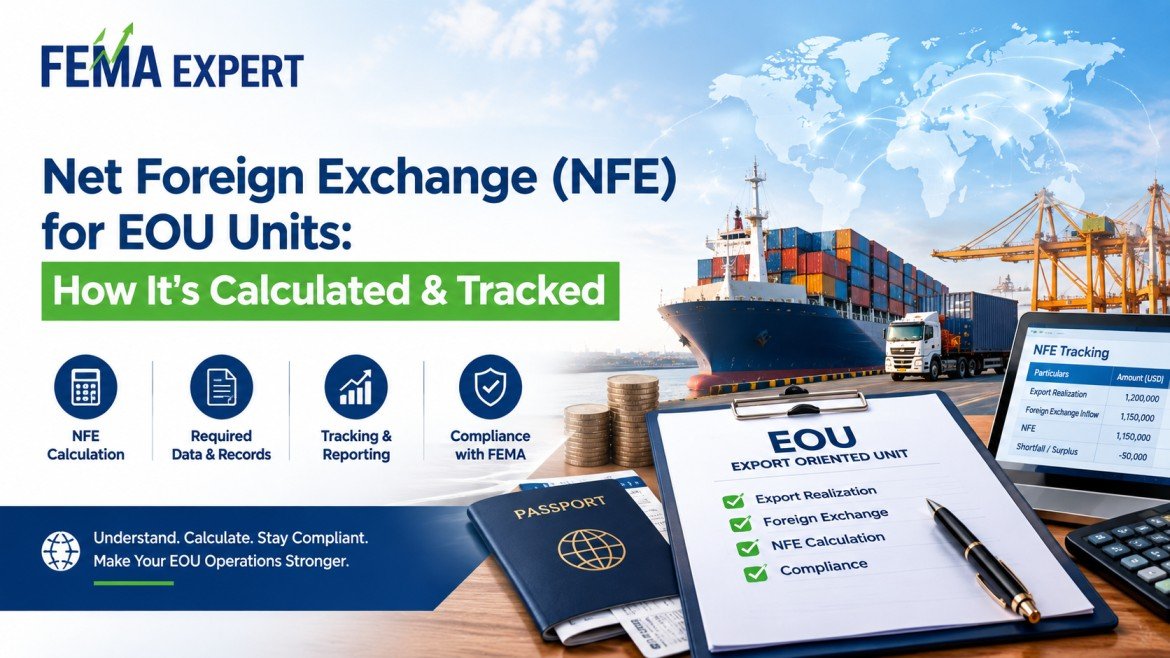

An EOU owner once thought exporting was enough. He shipped goods regularly. But his unit still failed a compliance review. He hadn’t tracked his imports against his exports properly.
This is a common gap. This guide covers NFE in EOU, the formula behind it, and what happens if you fall short.
Net Foreign Exchange measures whether your unit earns more foreign currency than it spends. It’s not just about exporting. It’s about the balance between what comes in and what goes out.
Every EOU and SEZ unit must maintain positive NFE. This is a core condition of the scheme, not a side detail.
EOU and SEZ schemes exist to boost India’s foreign exchange earnings. Duty-free imports come with a trade-off. The government expects genuine foreign exchange generation in return.
Without this condition, units could import freely, sell locally, and contribute nothing to export earnings. NFE closes that gap.
The formula works like this:
NFE = Total Foreign Exchange Earned − Total Foreign Exchange Spent
For the result to be positive, earnings must exceed outflows over the monitoring period. This isn’t calculated per shipment. It’s tracked cumulatively over time.
NFE isn’t judged year by year in isolation. It’s tracked over a 5-year block period.
This gives units flexibility. A slow first year doesn’t mean automatic failure. What matters is the cumulative position by the end of the block.
Units must maintain proper records of imports and exports throughout the block period. This data feeds into periodic reporting to the Development Commissioner’s office.
Accurate documentation matters here. Weak record-keeping makes it hard to prove your actual NFE position when it’s reviewed.
Falling short of NFE isn’t a minor compliance gap. It directly threatens the unit’s continued approval.
If a unit doesn’t meet positive NFE by the end of its block period, all isn’t necessarily lost. Extensions can be requested from the Unit Approval Committee, backed by a genuine explanation and a revised plan.
Approval isn’t guaranteed. The committee reviews the reasons behind the shortfall before deciding whether to grant more time.
| Basis | NFE | Export Obligation |
|---|---|---|
| What it measures | Net foreign exchange balance | Specific export commitment value |
| Applies to | EOU and SEZ units | Schemes like Advance Authorisation |
| Calculation basis | Earnings minus outflows | Export value against import value |
| Monitoring period | 5-year block | Typically 18 months |
Both concepts sound similar but serve different schemes with different rules.
FEMA Expert works closely with EOU and SEZ units to keep their NFE numbers on track, well before a compliance review turns into a scramble.
Trade compliance rarely stays isolated. When NFE tracking overlaps with wider investment or borrowing matters, our FEMA advisory specialists step in, and our ECB expert team supports units funding operations through external commercial borrowings.
Not sure where your unit currently stands on NFE? Get in touch with FEMA Expert for a review.
NFE compliance decides whether your EOU keeps its benefits or faces penalties. Understanding the formula, the block period, and what counts on each side helps you stay ahead of any shortfall before it becomes a problem.
If you need help tracking or reporting your unit’s NFE position, FEMA Expert’s team can guide you through it.
1. What is Net Foreign Exchange (NFE) in EOU?
It’s the difference between foreign exchange earned through exports and foreign exchange spent on imports, which every EOU must keep positive.
2. How is NFE calculated?
Using the formula: total foreign exchange earned minus total foreign exchange spent, tracked cumulatively over the monitoring period.
3. Over what period is NFE monitored?
Over a 5-year block period, not on a single-year basis.
4. What happens if an EOU fails to achieve positive NFE?
It can face penal action, possible cancellation of its Letter of Permission, and liability to repay duty benefits already availed.
5. Can a unit get more time if it falls short of NFE?
Yes, extensions can be requested from the Unit Approval Committee, though approval depends on the reasons provided.
6. Is NFE the same as export obligation?
No, NFE measures a net foreign exchange balance for EOU/SEZ units, while export obligation applies to schemes like Advance Authorisation with different monitoring periods.
7. What counts as foreign exchange earnings for NFE?
Mainly the FOB value of exports and service exports where foreign currency is received.
8. How can FEMA Expert help with NFE compliance?
We help EOU and SEZ units track their NFE position, prepare documentation, and manage compliance reviews with accurate reporting.