



Any time foreign money enters an Indian company through equity whether it’s a fresh share issue or a transfer of existing shares it has to be reported to the RBI. This is where FEMA form filing comes in.
Two forms handle most of this reporting: Form FC-GPR and Form FC-TRS. They look similar on paper, but they cover completely different transactions. Getting them mixed up, or missing the filing deadline, can lead to penalties under FEMA.
This guide breaks down both forms in simple terms what they are, when to file them, and how the process actually works.
FEMA forms are the reporting documents companies use to tell the RBI about foreign exchange transactions mainly foreign investment coming into an Indian entity. This falls under the broader FDI policy framework, which governs how much foreign investment is allowed, in which sectors, and how it must be reported.
Filing these forms isn’t optional. Once foreign investment is received or shares change hands between a resident and a non-resident, the relevant form has to be filed within a set timeline through the RBI’s FIRMS portal.
FC-GPR stands for Foreign Currency-Gross Provisional Return. That’s the FCGPR full form, and it’s filed when an Indian company issues new shares to a foreign investor in exchange for foreign investment received.
In simple terms:
what is FCGPR? It’s the form that reports a fresh allotment of shares to a non-resident investor, confirming that the company has issued capital and received the corresponding foreign funds.
FC-TRS stands for Foreign Currency-Transfer of Shares. That’s the FC-TRS full form also written as FCTRS.
Unlike FC-GPR, this form isn’t about new shares. It’s filed when existing shares are transferred between a resident and a non-resident for example, a foreign investor buying shares from an Indian shareholder, or an Indian resident selling shares to someone based outside India.
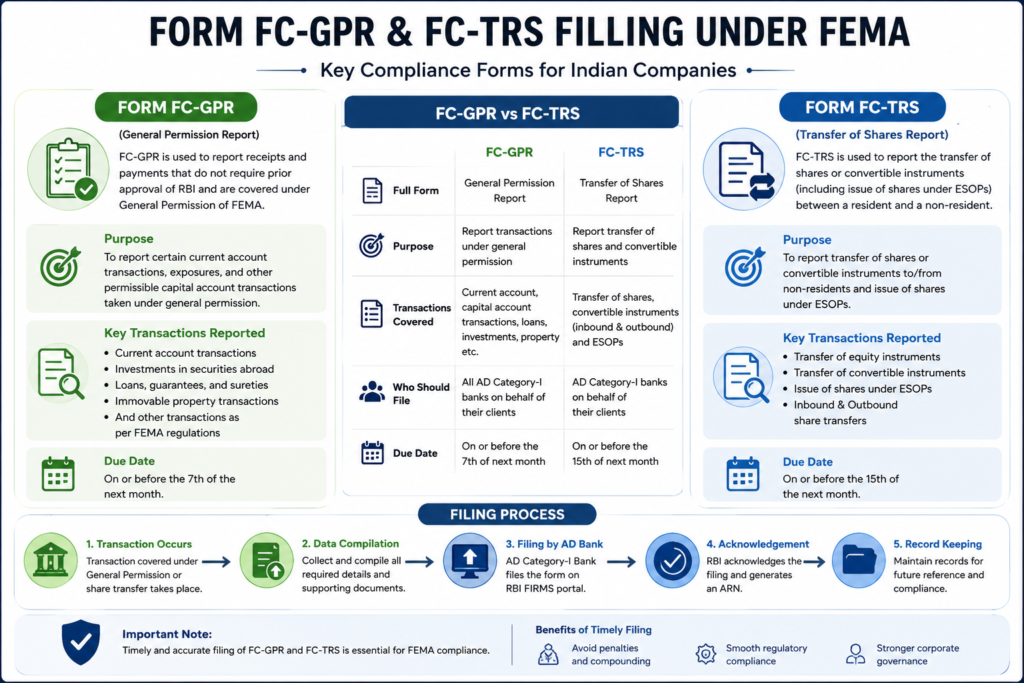
Both forms are filed through the same RBI FIRMS portal, but the transaction type and responsible party are different.
Both forms sit within the RBI’s foreign investment reporting system, which is designed to:
And it’s not just about avoiding a penalty messy FEMA records have a way of showing up during due diligence, and that can slow down or complicate a future fundraise.
Form FC-GPR must be filed within 30 days from the date shares are allotted to the foreign investor. The FCGPR filing due date is calculated from the allotment date, not the date funds were received.
Form FC-TRS must be filed within 60 days from the date of receipt or transfer of consideration for the share transfer whichever is applicable to the transaction.
Step 1: Receive Foreign Investment The company receives investment from a foreign entity in exchange for new shares.
Step 2: Obtain KYC of Foreign Investor This is collected from the investor’s overseas bank, confirming their identity and details.
Step 3: Valuation Certificate from a SEBI-Registered Merchant Banker/CA The share price must be supported by a proper valuation report.
Step 4: Register on the RBI FIRMS Portal The company or its representative must create an entity user on the FIRMS portal if not registered yet.
Step 5: Submit Form FC-GPR with Supporting Documents. Upload all documents and submit the form through the AD Bank.
Step 6: AD Bank Verification & RBI Acknowledgement The AD Bank checks the filing and sends it to the RBI. Then, the RBI issues an acknowledgment.
Step 1: Execute the Share Transfer Agreement. The buyer and seller finish signing the agreement.
Step 2: Get Valuation Certificate A CA or merchant banker will confirm the fair value of the shares you’re transferring.
Step 3: Register on the RBI FIRMS Portal If you’re not registered, create your account on the portal.
Step 4: File Form FC-TRS with Transaction Details Submit the form along with all transaction and party details.
Step 5: AD Bank Verification & RBI Acknowledgment The AD Bank checks the filing. Then, it sends it forward. Once satisfied, the RBI gives its acknowledgment.
Missing these windows doesn’t stop the filing from happening but it does trigger a late fee.
Delayed filing of either form attracts a Late Submission Fee (LSF), calculated based on how late the filing is and the transaction amount involved. In more serious cases of non-compliance, the matter can be escalated to compounding proceedings under FEMA, which involves a formal application to regularise the violation.
FC-GPR and FC-TRS filings involve valuation rules, portal registration, and strict deadlines and a small error can delay the acknowledgement or attract penalties. A FEMA expert helps businesses handle this correctly from the start, rather than fixing issues after the fact.
At FEMA Expert, we handle fema form filing end to end from identifying whether your transaction needs FC-GPR or FC-TRS, to preparing documentation, coordinating with your AD Bank, and tracking the filing through to RBI acknowledgement. Our team also supports the compliance work around foreign investment more broadly, including sectoral caps under the FDI policy and ongoing FEMA reporting.
Whether your company is issuing new shares to a foreign investor or facilitating a share transfer between a resident and non-resident, getting Form FC-GPR or Form FC-TRS filed correctly and on time protects you from penalties and keeps your FEMA compliance record clean. If you’re unsure which form applies to your transaction, it’s worth getting it checked before the deadline approaches.
Need help with FC-GPR or FC-TRS filing? FEMA Expert’s team can guide you through the entire process.
1. What is Form FC-GPR?
It’s the form filed to report the issue of new shares by an Indian company to a foreign investor in exchange for foreign investment.
2. What is Form FC-TRS?
It’s the form filed to report the transfer of existing shares between a resident and a non-resident.
3. What is the FCGPR filing due date?
Form FC-GPR must be filed within 30 days from the date of share allotment.
4. What is the due date for FC-TRS filing?
Form FC-TRS must be filed within 60 days from the date of receipt or transfer of consideration.
5. What is the difference between FC-GPR and FC-TRS?
FC-GPR reports a fresh issue of shares to a foreign investor, while FC-TRS reports the transfer of existing shares between resident and non-resident parties.
6. Who is required to file Form FC-GPR?
The Indian company that has allotted shares to a foreign investor.
7. Who is required to file Form FC-TRS?
The resident party involved in the share transfer either the buyer or the seller, depending on the transaction.
8. What happens if FC-GPR or FC-TRS is filed late?
A Late Submission Fee applies, and in serious cases, the matter may need to be resolved through compounding proceedings under FEMA.
9. Which portal is used to file FC-GPR and FC-TRS?
Both forms are filed through the RBI’s FIRMS portal, via the company’s Authorised Dealer (AD) Bank.
10. How can FEMA Expert help with FC-GPR and FC-TRS filing?
We handle the full filing process identifying the correct form, preparing documentation, coordinating with your AD Bank, and ensuring the filing is completed within RBI’s timelines.