


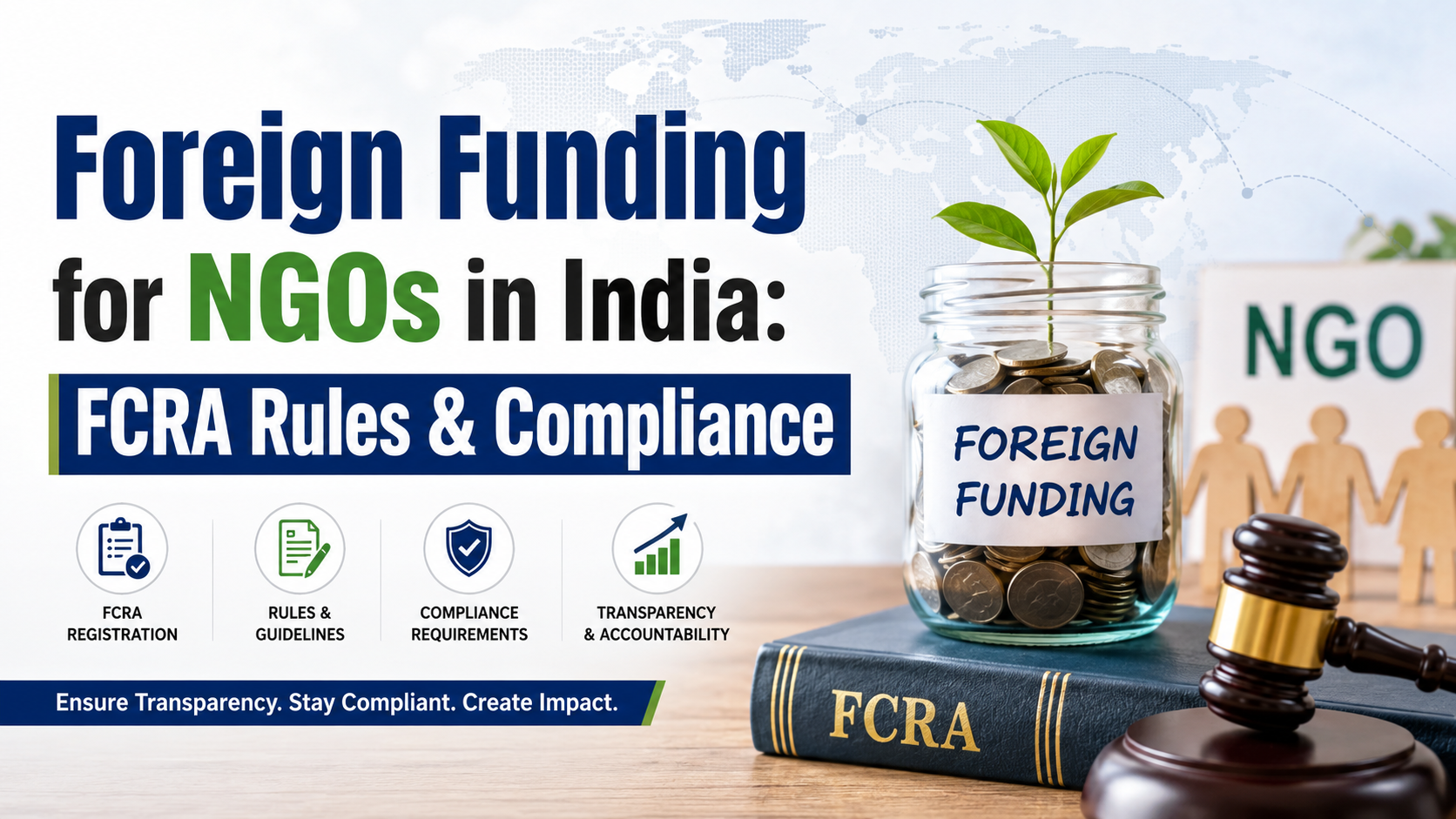
Foreign funding has become an important source of financial support for many non-governmental organisations (NGOs), charitable trusts, societies, and non-profit organisations in India. It helps these organisations implement social welfare projects, educational programmes, healthcare initiatives, disaster relief activities, and community development projects. However, receiving foreign funding in India is regulated under strict legal provisions to ensure transparency and accountability.
The Foreign Contribution (Regulation) Act (FCRA), 2010 governs the acceptance and utilisation of foreign contributions by eligible organisations. Every NGO planning to receive overseas donations must comply with the registration, reporting, and utilisation requirements prescribed by the Ministry of Home Affairs (MHA).
What is Foreign Funding?
Foreign funding refers to financial contributions, grants, donations, gifts, or other forms of monetary assistance received from individuals, organisations, foundations, or institutions located outside India.
Foreign contributions may include:
- Monetary donations
- Grants from international organisations
- Foreign charitable contributions
- Donations from overseas individuals
- Contributions from foreign companies
- International development assistance
The primary objective of foreign funding is to support activities that promote education, healthcare, environmental protection, social welfare, research, humanitarian relief, and public development.
However, organisations cannot freely accept foreign funding in India without complying with the applicable FCRA regulations.
What is the Foreign Contribution (Regulation) Act (FCRA)?
The Foreign Contribution (Regulation) Act (FCRA) is a law enacted by the Government of India to regulate the acceptance and utilisation of foreign contributions by individuals and organisations.
The Act aims to:
- Ensure transparency in foreign donations
- Prevent misuse of overseas funds
- Protect national interests
- Promote accountability among NGOs
- Regulate foreign contributions through authorised channels
The Ministry of Home Affairs (MHA) administers the FCRA and monitors compliance by registered organisations.
Why is FCRA Important for NGOs in India?
FCRA provides a structured legal framework for organisations receiving overseas contributions. It ensures that foreign donations are utilised only for approved charitable purposes and are properly accounted for.
The law also protects donor confidence by encouraging financial transparency and responsible utilisation of funds.
Proper compliance helps organisations:
- Receive foreign donations legally
- Build credibility with international donors
- Maintain transparent financial records
- Avoid regulatory action
- Continue long-term social development projects
Although discussions around investment often focus on the advantages of FDI, NGOs operate under an entirely different legal framework. Foreign contributions received by charitable organisations are regulated under FCRA rather than India’s FDI policy, making compliance essential before accepting international donations.
Who Can Receive Foreign Funding in India?
Only eligible organisations satisfying the conditions prescribed under FCRA can legally receive foreign contributions.
Eligible organisations generally include:
- Charitable Trusts
- Registered Societies
- Section 8 Companies
- Educational Institutions
- Healthcare Organisations
- Research Institutions
- Religious Organisations
- NGOs involved in public welfare
Each organisation must satisfy eligibility conditions before applying for registration or prior permission.
Eligibility Criteria for FCRA Registration
Before applying, an organisation should generally meet the following conditions:
Basic Eligibility Requirements
- Registered under the applicable Indian law
- Genuine charitable objectives
- Active operations for at least three years (for normal registration)
- Minimum prescribed expenditure on charitable activities (where applicable)
- Proper governing body
- Clean legal and financial record
- Dedicated FCRA bank account
Organisations seeking funding for a specific project may instead apply under the Prior Permission category if they do not yet qualify for regular registration.
Types of FCRA Registration
There are two primary ways organisations can receive foreign contributions.
Normal Registration
Normal registration is suitable for organisations that have been actively carrying out charitable activities for several years and meet the eligibility requirements under FCRA.
It allows organisations to receive foreign contributions continuously after registration.
Prior Permission
Prior Permission is designed for newly established organisations that intend to receive a specific foreign contribution from a particular donor for a defined project.
Approval is granted only for that particular donation and project.
Sources of Foreign Contribution
Foreign contributions may be received from:
- International charitable organisations
- Foreign foundations
- Foreign governments
- International NGOs
- Overseas corporate donors
- Foreign citizens
- Foreign educational institutions
- International development agencies
Every contribution must comply with FCRA regulations regardless of the source.
Activities Permitted Under FCRA
Registered organisations may utilise foreign contributions for approved charitable purposes, including:
- Education
- Healthcare
- Rural development
- Women’s empowerment
- Environmental protection
- Disaster relief
- Child welfare
- Skill development
- Social development programmes
- Research and awareness initiatives
Funds should always be utilised only for the objectives stated in the organisation’s registration documents.
Activities Restricted Under FCRA
Certain activities are prohibited or restricted under FCRA.
Examples include:
- Political activities
- Election-related activities
- Personal financial benefits
- Speculative investments
- Activities contrary to national interest
- Transfer of foreign contribution to ineligible organisations
Proper utilisation of funds is one of the most important compliance requirements under the Act.
Documents Required for FCRA Registration
The following documents are generally required while applying for FCRA Registration or Prior Permission.
Common Documents
- Registration Certificate of the NGO, Trust, Society, or Section 8 Company
- PAN Card of the organisation
- Memorandum of Association (MOA) or Trust Deed
- Registration Certificate under the applicable Act
- PAN and Aadhaar of office bearers
- Identity and address proof of key members
- Details of the Executive Committee or Governing Body
- Activity Report of the organisation
- Audited Financial Statements
- Bank account details (FCRA-designated bank account)
- Commitment letter from the foreign donor (for Prior Permission)
- Project proposal (if applicable)
- Passport-size photographs of authorised signatories
- Any additional documents requested by the Ministry of Home Affairs (MHA)
Preparing complete documentation helps avoid unnecessary delays during the registration process.
Step-by-Step FCRA Registration Process
Obtaining FCRA registration involves a structured application and verification process.
Step 1: Check Eligibility
Verify whether the organisation meets the prescribed eligibility conditions for either Normal Registration or Prior Permission.
Step 2: Prepare Required Documents
Collect registration certificates, governing documents, financial statements, activity reports, bank details, and supporting documents required for the application.
Step 3: Submit Online Application
File the appropriate FCRA application through the online portal of the Ministry of Home Affairs along with all supporting documents.
Step 4: Verification by Authorities
The authorities examine the application, verify organisational details, review financial records, and may conduct additional verification where required.
Step 5: Approval and Registration
Upon successful verification, the Ministry of Home Affairs grants FCRA Registration or Prior Permission, allowing the organisation to legally receive foreign contributions.
FCRA Compliance Requirements After Registration
Receiving registration is only the beginning. Organisations must continue complying with ongoing regulatory obligations.
Major compliance requirements include:
- Filing the Annual Return (Form FC-4) within the prescribed timeline
- Maintaining a dedicated FCRA bank account
- Using foreign contributions only for approved charitable purposes
- Maintaining proper books of accounts and supporting records
- Reporting changes in office bearers, address, or bank account to MHA
- Applying for renewal before registration expiry
- Maintaining complete transparency in fund utilisation
Regular compliance helps organisations maintain credibility with both regulators and foreign donors.
Common Reasons for FCRA Registration Rejection
Applications may be rejected due to:
- Incomplete documentation
- Incorrect information in the application
- Failure to satisfy eligibility conditions
- Poor compliance history
- Unclear charitable objectives
- Financial irregularities
- Non-compliance with FCRA provisions
Professional review before submission significantly reduces the chances of rejection.
Penalties for FCRA Non-Compliance
Failure to comply with FCRA provisions can lead to serious consequences, including:
- Monetary penalties
- Suspension of FCRA Registration
- Cancellation of registration
- Restriction on receiving future foreign contributions
- Investigation by regulatory authorities
- Legal proceedings under applicable laws
Organisations should therefore establish strong internal compliance systems and conduct regular reviews of their foreign contribution activities.
Best Practices for Managing Foreign Funding
Effective management of foreign contributions requires proper governance and financial discipline.
Some recommended practices include:
- Maintain accurate accounting records.
- Use funds only for approved objectives.
- File statutory returns on time.
- Conduct periodic internal compliance reviews.
- Preserve all supporting documents.
- Monitor regulatory updates issued by MHA.
- Train staff on FCRA compliance requirements.
- Seek professional guidance whenever regulatory changes occur.
These practices help organisations utilise foreign funding responsibly while maintaining full legal compliance.
Benefits of Professional FCRA Advisory Services
Professional advisory services help organisations navigate complex compliance requirements efficiently.
Benefits include:
- Assistance with FCRA Registration and Prior Permission
- Documentation review and application support
- Annual filing assistance
- Compliance monitoring
- Regulatory advisory
- Risk identification and mitigation
- Ongoing compliance support
Experienced consultants also help organisations remain updated with changes in FCRA regulations and reporting obligations.
Why Choose FEMA Expert for FCRA Registration & Compliance?
FEMA Expert provides end-to-end assistance for organisations seeking FCRA Registration, Prior Permission, annual return filing, and ongoing compliance management. Our professionals assist NGOs, trusts, societies, and Section 8 companies with documentation, application preparation, regulatory advisory, and compliance support. We help organisations receive and manage foreign funding in India confidently while ensuring complete adherence to applicable FCRA regulations.
Conclusion
Foreign contributions enable NGOs and charitable organisations to expand their social impact, but accepting overseas funds also brings significant legal responsibilities. Understanding FCRA rules, maintaining proper documentation, and completing timely compliance are essential for protecting an organisation’s registration and reputation.
If your organisation plans to receive foreign funding in India or requires assistance with FCRA Registration, annual filing, or ongoing compliance, FEMA Expert offers professional advisory services to help you navigate every stage of the compliance process with confidence.
(FAQs)
1. What is foreign funding?
Foreign funding refers to donations, grants, gifts, or financial assistance received from foreign individuals, organisations, governments, or institutions by eligible organisations in India.
2. Is FCRA registration mandatory?
Yes. Organisations intending to receive foreign contributions on a regular basis must obtain FCRA Registration or Prior Permission before accepting overseas donations.
3. Who regulates FCRA in India?
The Ministry of Home Affairs (MHA), Government of India, administers and regulates FCRA Registration, compliance, and reporting.
4. What is Prior Permission under FCRA?
Prior Permission allows a newly established organisation to receive a specific foreign contribution from a particular donor for an approved project.
5. What is Form FC-4?
Form FC-4 is the annual return that registered organisations must file to report the receipt and utilisation of foreign contributions.
6. Can individuals receive foreign funding?
Generally, FCRA primarily regulates foreign contributions received by organisations. Individual eligibility depends on the applicable legal provisions.
7. What happens if an NGO violates FCRA rules?
Non-compliance may result in penalties, suspension, cancellation of registration, and restrictions on receiving future foreign contributions.
8. How can FEMA Expert help?
FEMA Expert assists organisations with FCRA Registration, documentation, annual filing, compliance reviews, advisory services, and ongoing regulatory support to ensure smooth and lawful management of foreign contributions.