



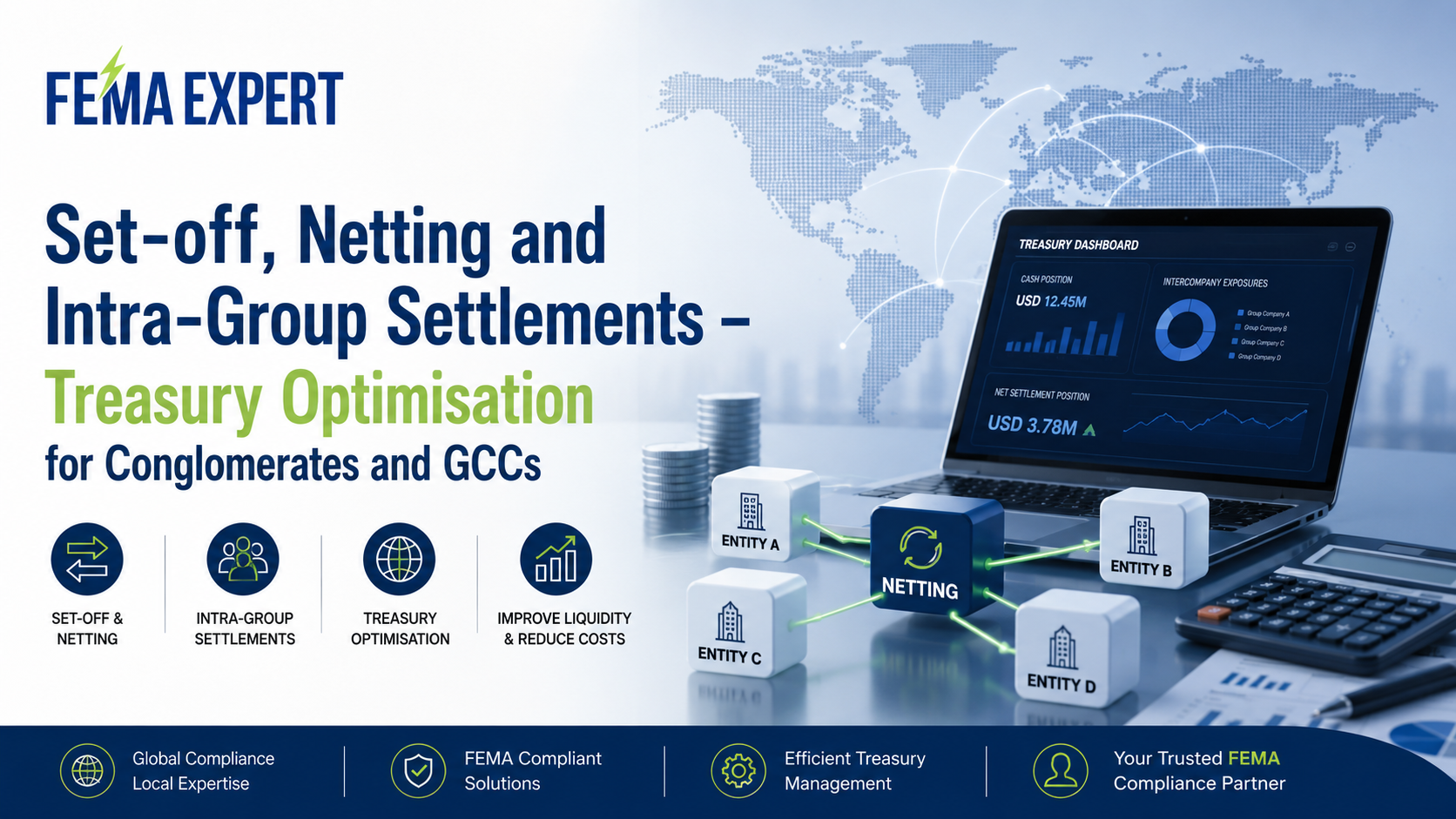
Treasury Optimisation for Conglomerates increasingly depends on how well groups deploy Netting, set-off and Group Settlements to manage liquidity, FX volatility and banking cost across many entities and currencies. When designed properly, these mechanisms turn a messy web of intercompany flows into a disciplined internal market for cash rather than a stream of ad‑hoc cross‑border payments.
Conglomerates and Global Capability Centers (GCCs) process hundreds or thousands of intercompany invoices every month for shared services, IT, R&D, regional management, royalties and internal funding. Treating each of these as a standalone payment creates duplication: every payment triggers FX conversion, bank charges, compliance checks and reconciliation work in multiple ledgers.
In global treasury practice, the core objectives in this environment are clear:
For large groups, Netting and Group Settlements are therefore not peripheral tools; they sit at the centre of Treasury Optimisation for Conglomerates as structural design choices.
Netting, legal set-off and group-level settlements work together as the operating system of a modern intercompany treasury model.
Intercompany Netting offsets reciprocal payables and receivables so that each entity pays or receives only a net amount, instead of settling every invoice separately.
There are two main flavours:
In a typical multilateral run, entities upload their open intercompany items from local ERPs into a netting system, disputes are resolved, and a single net settlement instruction is sent to or from a central netting hub per entity per cycle.
Set-off is the legal mechanism that allows mutual obligations between entities to be offset so that only the residual balance remains payable. Intercompany agreements and netting rules need explicit set-off clauses so that net positions are enforceable in each relevant jurisdiction and clearly treated under local corporate and insolvency laws. This reduces gross exposure between entities and clarifies how balances will be handled if an entity faces distress.
Group Settlements occur when a central entity, often an in-house bank or regional treasury centre, becomes the single counterparty for intercompany flows. Instead of dozens of bilateral payments, each subsidiary settles its net position periodically with this central entity, often in its functional currency.
Over time, this netting centre can evolve into a full in‑house bank, providing:
Bilateral and multilateral netting pursue the same goal—reducing the number of settlements and exposures—but they do so in very different ways.
Bilateral netting is straightforward: two entities with recurring flows compare their open invoices, offset them and settle a single net amount on agreed dates. For a group with only a few entities, this can be simple to put in place, requires limited tooling and can be managed through basic schedules and reconciliations.
The drawback is scalability: once the group has dozens of entities, the number of bilateral relationships explodes, and treasury teams end up maintaining many overlapping bilateral schedules and reconciliations. Even with bilateral netting, the total number of payments and bank statements remains high because each pair of entities still settles separately.
Multilateral netting replaces that web of bilateral flows with a single relationship between each participating entity and the netting centre. All open intercompany items are uploaded to one platform, matched and netted, and each entity settles a single net amount per cycle, often monthly.
Experience from corporates that have implemented multilateral netting shows:
Treasury surveys highlight that high banking fees and FX spreads are among the top pain points leading organisations to adopt multilateral netting, precisely because compressing payments at scale directly attacks these costs.
In short:
For a CFO overseeing Treasury Optimisation for Conglomerates with double‑digit subsidiaries and multi‑currency flows, the benefits of multilateral netting almost always outweigh the additional design effort, provided legal and system foundations are in place.
In a traditional model, every intercompany invoice paid across borders uses the external banking system, often involving an FX conversion, a wire fee and local processing work on both sides.
Netting compresses those flows at multiple levels:
Case studies from treasury networks show that multilateral, multi‑currency netting programmes can:
The cost reduction logic is structural: if the group executes fewer transactions at better FX rates, and covers them with leaner processes, total cost must fall.
Without technology, maintaining a sophisticated netting and Group Settlement model quickly becomes unmanageable. That is why modern Treasury Management Systems sit at the core of advanced netting programmes.
A TMS typically supports:
Vendors now offer specialised intercompany netting solutions embedded in or connected to TMS platforms, designed to reduce FX and transaction costs and to operate netting cycles across currencies and jurisdictions. Leading treasuries increasingly use these tools to turn netting into a daily or weekly, highly automated process rather than a manual monthly exercise.
Global Capability Centers play a growing role as operational and sometimes legal hubs for treasury and finance functions in large groups. Policymakers promoting international financial centres position modern treasury centres as engines for transaction netting, cash visibility and technology‑enabled risk management.
In practice, GCCs use Netting and Group Settlements to:
When GCCs combine these roles with a strong TMS and netting platform, they become the operational heart of Treasury Optimisation for Conglomerates, especially for internal funding and service‑fee recoveries.
For a CFO, the challenge is less about “whether to net” and more about how to design a netting framework that is efficient, compliant and scalable.
| Dimension | Traditional intercompany settlement | Optimised netting and group settlement |
|---|---|---|
| Number of payments | Many cross‑border payments per month per entity, often one per invoice. | One net payment or internal settlement per entity per cycle, often monthly. |
| Bank and FX costs | Multiple small FX conversions at local spreads and per‑transaction fees. | Fewer, larger FX trades at group level with better spreads and lower bank charges. |
| Reconciliation effort | High volume of bank entries and invoices to match across many counterparties. | Centralised reconciliation in the netting centre and far fewer items per entity. |
| Liquidity management | Cash and FX positions fragmented across subsidiaries; limited real‑time visibility. | Liquidity centralised in treasury or GCC, with better visibility and control of group cash. |
| Process automation | Often manual or ERP‑specific, with different controls and formats per bank. | TMS‑driven netting runs, in‑house bank structures and harmonised payment workflows. |
| Risk and control | Decentralised execution, inconsistent approval frameworks and audit trails. | Central policies, standardised documentation and a single point of accountability. |
The efficiency and cost gains are not theoretical: they come from doing structurally fewer transactions, at scale, under a more disciplined process. If you have any query regarding Treasury Optimisation for Conglomerates you can connect to Fema Consultant that will be guide you better.
Because multilateral netting relies on legal set‑off, enforceability depends on robust netting and set‑off clauses in intercompany agreements and compliance with local insolvency and corporate law. Many groups appoint a specific netting or in‑house bank entity as counterparty, with standardised documentation, so that only net positions remain outstanding and treatment in a distress scenario is clearer.
Netting changes how and when cash moves, but not the underlying business rationale for intercompany services or funding; pricing must still be arm’s length and aligned with the group’s transfer pricing policies. With global rules such as BEPS and Pillar Two, tax authorities are paying more attention to treasury centres and internal banks, so clear documentation of functions, risks and remuneration is essential.
Authorities may question structures that concentrate cash and risk offshore without corresponding substance, decision‑making and appropriate returns. The response is to build genuine capability in the GCC or treasury centre, document its role, align pricing with that role, and maintain transparent records from the TMS and netting system showing all underlying transactions and FX effects.
Some countries restrict cross‑border netting, limit intercompany loans or allow netting only in local currency, which can affect which entities join a global netting pool and how regional hubs are structured. Treasuries need to map these constraints up front and, where needed, run regional netting schemes or use local cash pooling alongside global frameworks.
A pragmatic approach is to start with a pilot scope—selected entities and transaction types—while running parallel “shadow” netting to validate calculations before going live. Using the TMS or netting tool to clean intercompany data, publish a clear netting calendar and agree dispute‑handling rules with controllers builds confidence before the first real Group Settlements flow through the new model.
For conglomerates and GCCs, Netting, set‑off and Group Settlements are therefore not just process improvements; they are foundational elements of a more strategic approach to liquidity management, FX risk and cost efficiency at group scale.