
Exporting from India involves more than finding international buyers. Businesses must also manage manufacturing expenses, freight charges, packaging costs, taxes, and banking fees. If these expenses are not planned properly, they can reduce the profit earned from each export order.
To help businesses manage these costs, the Indian government offers several export-related schemes and tax benefits. Depending on the business and its eligibility, exporters may receive duty relief, tax refunds, or other financial support.
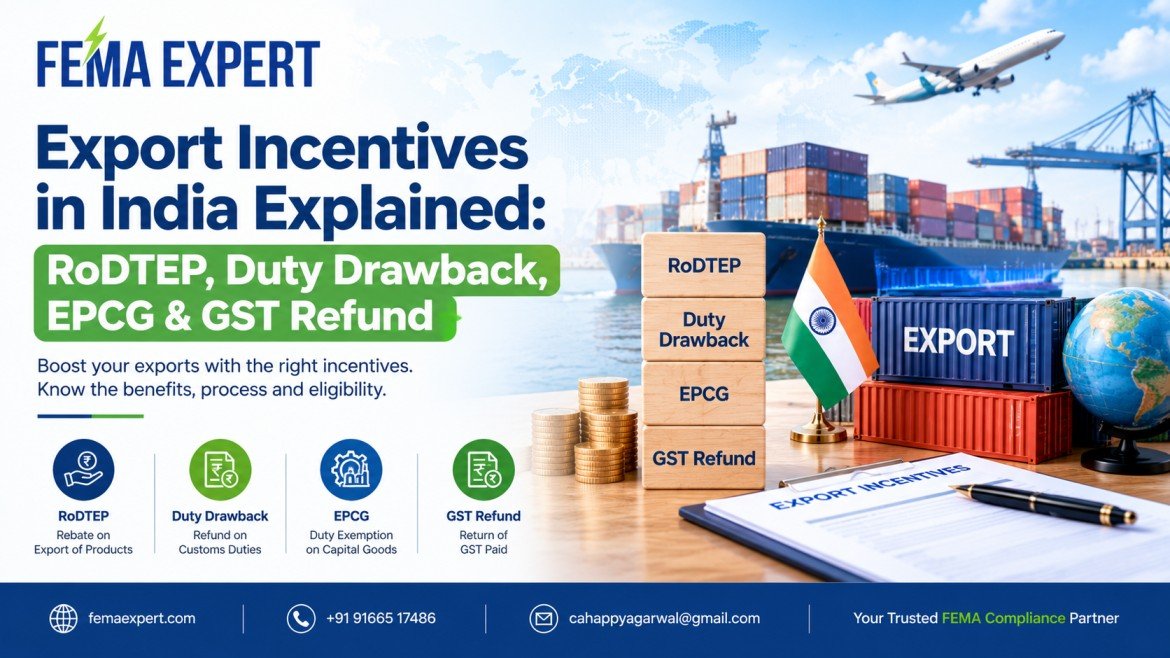
This guide covers the major export incentives in India, including RoDTEP, Duty Drawback, EPCG, Advance Authorisation, RoSCTL, and GST refunds. It explains how these schemes work, who may qualify, and what exporters should check before applying.
Export incentives are benefits available under specific government policies to support eligible businesses involved in international trade. Some schemes reduce the cost of importing materials or machinery, while others provide relief for certain taxes associated with exports.
Different authorities manage different parts of the process:
Not every exporter qualifies for every scheme. The appropriate option depends on the goods or services being exported, the inputs used, and the conditions specified under the relevant policy.
| Scheme | Main benefit | Businesses that may qualify |
|---|---|---|
| RoDTEP | Remission of eligible duties and taxes on exported products | Eligible goods exporters |
| Duty Drawback | Refund of eligible customs duties under applicable rules | Eligible goods exporters |
| EPCG | Reduced or zero customs duty on qualifying capital goods | Eligible manufacturers and service providers |
| Advance Authorisation | Duty-free import of specified inputs for export production | Eligible exporters using imported inputs |
| RoSCTL | Rebate of specified state and central levies | Eligible apparel and made-up textile exporters |
| GST Refund | Refund of eligible input tax credit or IGST, subject to the chosen route | Eligible goods and service exporters |
Scheme rules may change through government notifications. Exporters should confirm current rates, product coverage, eligibility, and validity periods before making business or pricing decisions.
Some older articles still discuss the Merchandise Exports from India Scheme (MEIS) and the Service Exports from India Scheme (SEIS) as available benefits. However, these schemes relate to earlier export policy periods and should not be assumed to be available for new exports.
Businesses should check current DGFT notifications to understand which benefits apply to their transactions.
RoDTEP stands for Remission of Duties and Taxes on Export Products. It provides eligible exporters with a notified benefit for certain duties, taxes, and levies associated with exported goods that are not refunded through other mechanisms.
The scheme can help exporters account for qualifying costs that remain part of their production expenses.
The amount depends on the product category and the rate specified in the applicable government schedule.
Rates vary across products. Exporters should check the latest notified schedule rather than assume that one percentage applies to every shipment.
Importing materials for export production can increase a manufacturer’s working capital requirements. Duty Drawback provides a mechanism for refunding eligible customs duties under the applicable customs provisions.
For example, a manufacturer may import components, pay customs duty, use those components to produce finished goods, and then export the final product. Depending on the applicable rules, the manufacturer may be able to claim Duty Drawback.
RoDTEP and Duty Drawback address different categories of costs. A business may qualify for both on the same shipment where the applicable rules permit it.
Advance Authorisation is designed for eligible exporters that require specified imported materials to manufacture products for export. The scheme allows qualifying inputs to be imported without applicable customs duties, subject to the conditions of the authorisation.
This option may be useful when imported raw materials make up a significant part of a product’s manufacturing cost. By reducing the upfront duty burden on qualifying inputs, a business can plan its production budget and working capital more effectively.
The scheme may suit eligible manufacturers and exporters that use imported materials in their export production.
Before applying, businesses should review:
Advance Authorisation does not allow unrestricted duty-free imports. Businesses must use the inputs according to the approved conditions and fulfil the applicable export obligations.
The Export Promotion Capital Goods (EPCG) scheme supports eligible businesses importing specified capital goods for their operations.
Under the scheme, qualifying machinery may be imported at zero or reduced customs duty. In return, the authorisation holder must fulfil the prescribed export obligation within the applicable period.
Machinery can represent a major investment for manufacturers and certain service providers. Reducing the upfront customs duty may lower the initial cost of installing or upgrading equipment.
Before choosing EPCG, businesses should assess:
The commonly cited EPCG requirement is an export obligation equal to six times the duty saved, generally to be fulfilled within six years. However, exporters should verify the exact obligation and timeline against the current policy and their authorisation.
The Rebate of State and Central Taxes and Levies (RoSCTL) scheme is intended to address eligible state and central levies embedded in the cost of certain apparel and made-up textile exports.
This benefit may be relevant to businesses exporting qualifying garments and textile products.
Before claiming the benefit, exporters should confirm whether their products fall within the notified coverage and review the current rates, scheme period, and documentation requirements.
GST treatment is an important part of export planning. Under Indian GST law, qualifying exports are treated as zero-rated supplies, subject to the applicable conditions.
This may allow eligible exporters to claim a refund through the permitted route.
An eligible exporter may export without paying IGST by furnishing a valid Letter of Undertaking (LUT), subject to the applicable rules.
The exporter may then claim a refund of eligible unutilised input tax credit, where permitted.
This route may be useful for businesses that regularly pay GST on eligible expenses such as software subscriptions, professional services, and other business purchases.
Where permitted by the applicable law, an exporter may pay IGST on the export and subsequently apply for a refund of the eligible tax paid.
The conditions, restrictions, and filing procedure should be checked before selecting this option.
Businesses providing IT services, consulting, design, or other professional services to overseas clients may qualify for GST-related export benefits.
The transaction must satisfy the applicable legal conditions concerning the service provider, recipient, place of supply, receipt of payment in convertible foreign exchange or permitted Indian rupees, and the relationship between the parties.
Service exporters should maintain their contracts, invoices, payment records, and other supporting documents. They should also verify the applicable refund deadline and filing requirements.
A transaction with a foreign client does not automatically qualify as an export of services. All relevant legal conditions must be met.
Apart from GST refunds, some businesses may qualify for additional support depending on their activities and registrations.
These options may include:
Businesses should verify the current conditions instead of assuming that every IT or service exporter automatically qualifies.
These schemes support exporters in different ways.
| Feature | RoDTEP | Duty Drawback | EPCG |
|---|---|---|---|
| Main purpose | Remission of eligible embedded taxes and levies | Refund of eligible customs duties | Reduce duty on eligible capital goods |
| When benefit arises | After eligible exports and processing | After eligible exports and processing | At the time of qualifying machinery import |
| Form of benefit | E-scrip | Refund or credit, as applicable | Customs duty concession |
| Export obligation | No separate EPCG-style obligation | Generally no separate EPCG-style obligation | Yes |
| Typical use | Eligible exported products | Eligible exported products or inputs | Machinery and capital equipment |
In some cases, yes. An eligible goods exporter may be able to claim RoDTEP and Duty Drawback on the same shipment if both benefits are permitted for that transaction.
A manufacturer may also use EPCG for eligible machinery and claim permitted export benefits on qualifying shipments. However, scheme-specific restrictions must be followed, and the same duty or tax cannot be refunded twice.
Correct shipping bill declarations and compliance with authorisation conditions are essential.
Exporters generally need to establish their business identity, maintain accurate transaction records, and meet the requirements of the chosen scheme.
Depending on the benefit, relevant documents may include:
The exact document list varies by scheme and transaction. Confirm the requirements before submitting an application or exporting goods.
The claim process depends on the selected scheme. The following steps provide a general starting point for goods exporters.
Apply for an Importer Exporter Code through DGFT if required for your export activity.
Review your product, business model, imported inputs, and machinery requirements to identify suitable benefits.
Confirm the correct HS code and review the relevant scheme schedules. Incorrect classification can lead to an incorrect claim or processing issues.
Ensure the shipping bill includes the required information and scheme declarations. Review these details before the goods are exported.
Monitor the relevant customs portal for claim status, e-scrips, or refunds. Complete any additional steps required under the scheme.
Keep invoices, shipping bills, packing lists, payment evidence, and other relevant documents organised for each shipment.
For GST refunds, review the applicable LUT or IGST route, file the required GST returns, maintain payment evidence, and submit the refund application through the GST portal where eligible.
Consider a business exporting eligible goods with an FOB value of ₹50 lakh.
The following figures are illustrative only. They are not notified rates for any specific product.
| Benefit | Illustrative rate | Illustrative amount |
|---|---|---|
| RoDTEP | 0.8% of FOB value | ₹40,000 |
| Duty Drawback | 1.5% of FOB value | ₹75,000 |
| Total illustrative recovery | 2.3% | ₹1,15,000 |
Actual benefits may differ. Duty Drawback is not necessarily calculated as a percentage of FOB value in every case, so the figures above should not be used for a real shipment without checking the applicable rules.
Even a relatively small recovery can affect an exporter’s profit margin. Businesses should calculate potential incentives carefully instead of assuming that every shipment will receive the same benefit.
Errors in product classification, declarations, records, and deadlines can delay a claim or affect eligibility.
Common mistakes include:
Maintaining a shipment-wise compliance checklist can help businesses identify missing information early.
Receiving payment from overseas customers and keeping evidence of the transaction are important parts of export compliance.
Depending on the transaction and applicable requirements, businesses may need bank-issued payment advice, remittance records, and other evidence to support their accounts or refund applications.
Exporters should regularly reconcile invoices, shipping bills, and bank records. They should also follow applicable foreign exchange requirements and resolve outstanding entries with their authorised bank.
The exact supporting documents depend on the transaction and regulatory requirements, so businesses should confirm what is required for each claim.
A few simple practices can make incentive management easier:
These practices can help reduce avoidable errors and make export planning more reliable.
FEMA Expert helps businesses understand regulatory and compliance requirements connected with international trade and cross-border transactions.
Exporters may need guidance on their compliance responsibilities, transaction records, and situations where customs, GST, foreign exchange, or other specialist advice is required.
Our advisory approach focuses on helping businesses understand their obligations and prepare for compliance more effectively. The support required depends on the nature of the export transaction and the scheme involved.
Before claiming an incentive, businesses should confirm their eligibility, review the latest official notification, and check all applicable deadlines.
Major options include RoDTEP, Duty Drawback, EPCG, Advance Authorisation, RoSCTL, and eligible GST refunds. The right option depends on the type of export and the conditions your business meets.
An exporter may qualify for both on the same shipment when the applicable rules permit it. Each scheme’s conditions must be met, and the same duty or tax cannot be refunded twice.
Eligible service exporters may claim refunds through the applicable GST route, including eligible unutilised input tax credit under an LUT or a refund of IGST where permitted. The transaction must meet the legal requirements for an export of services.
These schemes relate to earlier export policy periods and should not be treated as generally available benefits for new exports. Check current DGFT notifications for the schemes applicable to your business.
Start by identifying whether you export goods or services, whether you import raw materials or machinery, and whether your product qualifies under a notified scheme. Then review the current eligibility and documentation requirements, taking professional advice where needed.
Export incentives can help eligible Indian businesses manage certain costs and improve their competitiveness in international markets. RoDTEP and Duty Drawback may benefit qualifying goods exports, while EPCG and Advance Authorisation can support eligible machinery and input imports. Service exporters should review GST zero-rating and refund provisions, along with other benefits for which they qualify.
The right approach depends on your products, transactions, documentation, and the latest scheme rules. Verify official notifications before making financial decisions and maintain accurate records throughout the export process.