


A finance manager once asked us a simple question. “Do we still file Form 15CA for this payment?” It was July 2026. The answer surprised him.
Form 15CA doesn’t exist anymore. Not by that name, at least.
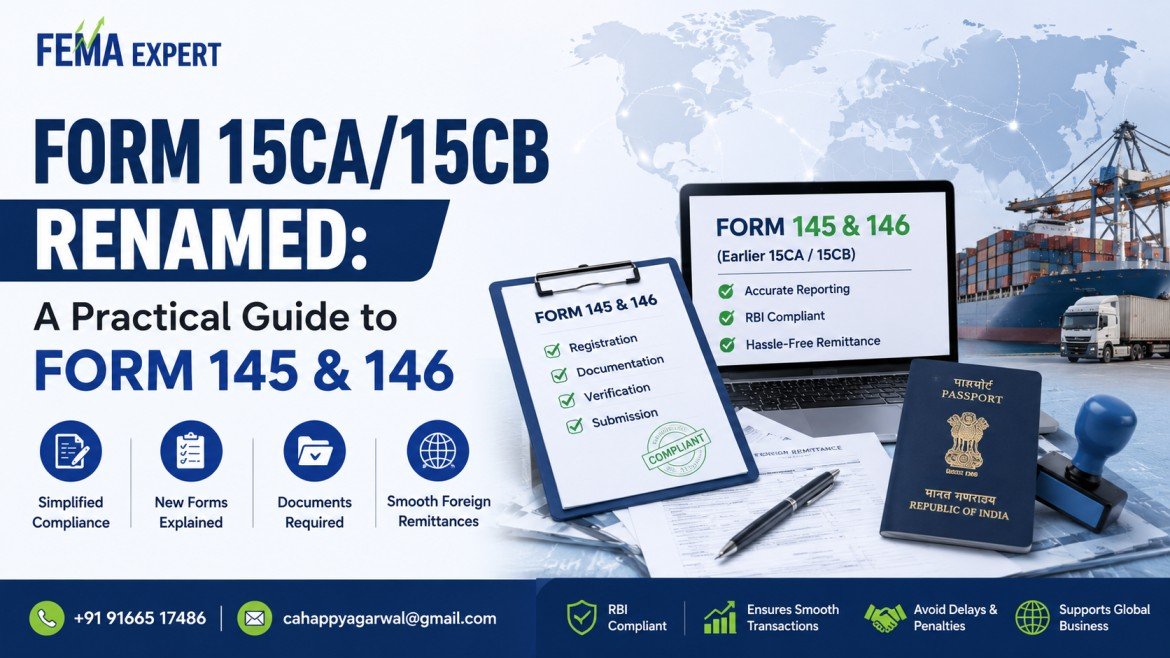
From 1 April 2026, Form 15CA and 15CB renamed to Form 145 and Form 146. The rules didn’t change much. But the numbers did. And a lot of businesses are still catching up.
This guide covers what changed, what stayed the same, and what you need to do now.
Form 145 income tax filing is your declaration before sending money to a non-resident or foreign company. It tells the tax department what’s being paid, to whom, and whether tax has been deducted.
Form 146 is different. It’s a certificate. A practising Chartered Accountant issues it, confirming the tax position on a specific remittance.
Simple way to remember it: Form 145 is your declaration. Form 146 is your CA’s backup for it.
The Income-tax Act, 2025 replaced the old 1961 Act. Along with it came the Income Tax Rules, 2026. Every prescribed form got renumbered.
Form 15CA became Form 145. Form 15CB became Form 146. The underlying purpose stayed the same. Only the labels changed, along with some section references.
Under the old law, Section 195 required TDS on payments to non-residents. That obligation now sits under Section 393 of the new Act.
Rule 37BB is what actually mandates the reporting. This rule still applies. It just points to updated section numbers now.
You need to file Form 145 before making a remittance, if that payment is taxable in India.
This applies broadly:
Two situations skip this requirement. First, when the payment simply isn’t taxable in India at all. Second, when it falls under Rule 37BB’s exempted list.
Around 33 specific payment types don’t need Form 145. Common ones include:
Here’s the catch. Don’t assume a payment qualifies just because it feels personal or routine. The list is specific, item by item. Check the exact category. Or better, confirm with your CA before skipping the filing.
Form 146 becomes necessary when two things are both true.
First, the remittance, or total remittances to that payee in the year, crosses Rs. 5 lakh. Second, the payment is taxable, and no Assessing Officer order already covers it.
Meet both conditions, and your CA needs to review your invoice, agreement, and any DTAA residency certificate. Then they certify the correct tax rate and TDS position.
This number decides how much paperwork you need.
Below Rs. 5 lakh, you file only the simpler Part A of Form 145. No CA certificate needed.
Above Rs. 5 lakh, and taxable, you need Form 146 first. That feeds into the fuller Part C of Form 145.
These two systems often get confused. They’re not the same thing.
| Feature | Form 145/146 | TCS on LRS Remittances |
| Who it applies to | Anyone paying a non-resident or foreign company | Individuals remitting under RBI’s LRS |
| What it does | Reports and certifies taxability | Collects tax upfront, adjustable as credit |
| Who handles it | Remitter files, CA certifies when needed | Bank collects at the time of remittance |
They can both apply to the exact same transfer. One doesn’t replace the other.
Step 1: Check taxability. Confirm whether the payment is chargeable to tax in India, and whether it’s on the Rule 37BB exempted list.
Step 2: Get Form 146, if needed. If taxable and above Rs. 5 lakh, get your CA to certify the tax position first.
Step 3: Log in to the e-filing portal. Access your account with your registered credentials.
Step 4: Fill in Form 145. Enter payment details, select the correct part, and attach Form 146 if applicable.
Step 5: Submit and download acknowledgement. You’ll get a reference number confirming the filing.
Step 6: Share it with your bank. The authorised dealer bank needs this before processing the remittance.
Skip this filing, or file it with wrong details, and Section 271-I kicks in. The penalty is Rs. 1,00,000 for each default.
Multiple remittances, multiple defaults. Each one can attract a separate penalty.
Section 273B offers relief if you can show reasonable cause for the failure. But it’s not automatic.
The burden is on you to prove it. And practically speaking, banks rarely process a remittance without the form filed first. So this relief scenario doesn’t come up as often as you’d think.
Remittances completed before 1 April 2026 stayed under the old Form 15CA and 15CB. No retrospective refiling needed.
Anything from 1 April 2026 onward uses Form 145 and 146. If your remittance workflow straddles this date, plan for both systems during the transition period.
At FEMA Expert, we help businesses and NRIs navigate this transition smoothly. We check taxability. We coordinate Form 146 certification. We handle Form 145 filing correctly, the first time.
Our team also works as your RBI and LRS remittance consultant, so both sides of your foreign remittance compliance stay handled together. This connects to our broader FEMA advisory support too.
Need help with an upcoming foreign remittance? Reach out to FEMA Expert before your payment date, not after.
The names changed. The core compliance didn’t. Whether you call it Form 15CA or Form 145, the goal is the same: confirm taxability, deduct the right TDS, and file before the money leaves India.
If you’re setting up remittance processes for FY 2026-27 and want to get the new form numbers right, FEMA Expert’s team can guide you through it.
1. What is Form 145 in income tax?
It’s the renamed version of Form 15CA, a declaration filed before making a taxable remittance to a non-resident or foreign company.
2. What happened to Form 15CB?
Form 15CB was renamed Form 146, effective 1 April 2026, under the Income-tax Act, 2025.
3. Do I still need to worry about the Rs. 5 lakh threshold?
Yes, it carries forward unchanged. Above this amount, taxable remittances need Form 146 before filing Form 145.
4. Is Form 145 different from TCS on LRS remittances?
Yes, they’re separate systems. A single remittance can require both Form 145 filing and TCS collection by the bank.
5. What’s the penalty for not filing Form 145?
Rs. 1,00,000 per default under Section 271-I, whether for non-filing or inaccurate details.
6. Do old Form 15CA filings need to be redone as Form 145?
No, remittances completed before 1 April 2026 remain valid under the old form numbers. No retrospective refiling is required.
7. Which payments are exempt from Form 145?
Payments on the Rule 37BB exempted list, around 33 specific categories, along with payments not chargeable to tax at all.
8. How can FEMA Expert help with Form 145 and 146 compliance?
We assess taxability, coordinate CA certification for Form 146, and manage Form 145 filing, alongside broader FEMA and LRS remittance advisory.