


India’s services sector has emerged as one of the most powerful engines of economic growth in the post-liberalisation era. As of November 2024, India’s services exports stood at $35.67 billion surpassing merchandise exports of $32.11 billion for the first time. By November 2025, Services Exports India FTA momentum pushed this figure to $35.86 billion, reflecting an 11.67% year-on-year growth.
With a target to exceed goods exports by 2030, India’s IT, healthcare, finance, legal, and professional services are at the centre of this growth story. However, this growth doesn’t happen in a vacuum. It is deeply tied to Preferential Trade Agreement India Services frameworks and, critically, FEMA Compliance Services Export obligations that every Indian service provider must meet to legally realise foreign exchange earnings.
If you are a business exporting services to the UK, Switzerland, Oman, or the EU you are operating at the intersection of trade law and foreign exchange law. Understanding both is not optional. It is essential.
For decades, India’s Free Trade Agreements focused primarily on goods tariff reductions, rules of origin, and customs procedures. But the new generation of FTAs is different. Today, services are at the heart of every major agreement India has signed or is negotiating.
The reason is simple: India’s comparative advantage lies in services. IT and IT-enabled services (ITeS), business process outsourcing (BPO), knowledge process outsourcing (KPO), healthcare, legal, accounting, engineering, and education these sectors employ millions and generate billions in foreign exchange.
Under GATS Mode 1 Mode 4 India frameworks, services can be exported in four ways:
• Mode 1 (Cross-border Supply): Service delivered digitally from India to a foreign buyer e.g., software development, back-office services.
• Mode 2 (Consumption Abroad): Foreign customer travels to India for the service e.g., medical tourism.
• Mode 3 (Commercial Presence): Indian company sets up a branch or subsidiary abroad.
• Mode 4 (Movement of Natural Persons): Indian professional travels abroad to deliver the service.
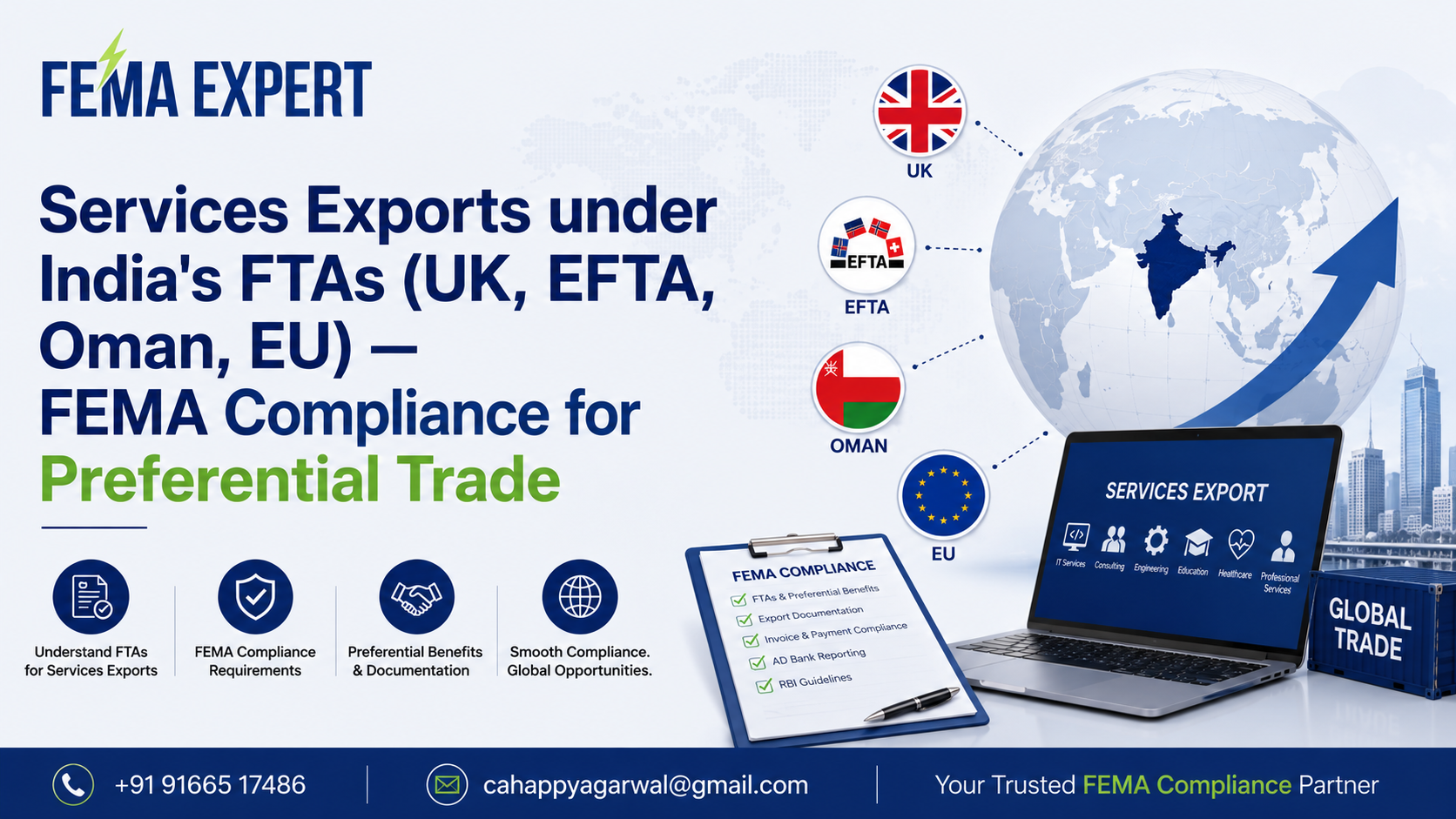
India’s FTAs with the UK, EFTA, Oman, and EU each have specific commitments under these modes. Understanding them is the first step toward claiming FTA benefits legally and correctly.
India UK CETA Services represents a landmark achievement. Concluded in 2025, the Comprehensive Economic and Trade Agreement (CETA) between India and the United Kingdom is India’s most comprehensive trade deal with a developed economy.
• India exported over US$ 19.8 billion in services to the UK in 2023 alone. CETA is designed to expand this further.
• For the first time, the UK has eased mobility for professionals across IT, healthcare, finance, and education a direct benefit under Mode 4 Professional Mobility India FTA provisions.
• Categories covered include: Contractual Service Suppliers (CSS), Business Visitors, Intra-Corporate Transferees (ICTs), and Independent Professionals.
• The Double Contribution Convention under CETA will save Indian firms and workers over ₹4,000 crore by eliminating the requirement for dual social security contributions in both India and the UK.
Every rupee earned from UK service exports must be received and reported under the Foreign Exchange Management Act Export Services framework. Key obligations include:
• Invoicing in foreign currency (GBP/USD/EUR) as per RBI guidelines.
• Realisation of export proceeds within 9 months from the date of invoice (extendable with AD Bank approval).
• Filing of SOFTEX form for software and IT exports with the designated AD Bank.
• AD Bank Reporting Services Export your Authorised Dealer (Category I) bank must receive and report all inward remittances.
• Obtaining Bank Realisation Certificate BRC Services upon receipt of payment essential for GST refund claims and proof of export.
India EFTA Agreement Services marks a historic milestone India’s first FTA with four developed European nations simultaneously: Switzerland, Norway, Iceland, and Liechtenstein.
• The Trade and Economic Partnership Agreement (TEPA), signed in 2024, improves market access for Indian pharmaceuticals, engineering goods, and services.
• The deal is backed by a landmark investment commitment: USD 100 billion in investment and creation of one million jobs in India over 15 years.
• For services, EFTA countries have made commitments across financial services, IT, consulting, and professional services.
• Mode 4 commitments allow Indian professionals to work in EFTA nations as ICTs, CSS, and independent professionals in specific sectors.
Receiving payments from Switzerland (CHF) or Norway (NOK) requires your AD Bank to correctly classify the inward remittance under the relevant purpose code. Incorrect purpose codes can lead to FEMA Section 7 Services Export violations and penalties. Always:
• Use the correct RBI Purpose Code for the type of service rendered.
• Ensure BRC Services (Bank Realisation Certificate) is obtained within the prescribed timeline.
• For multi-year contracts, ensure each tranche is separately reported.
India Oman CEPA Services, signed on 18 December 2025, is a transformative agreement for India’s professional and wellness services sectors.
• For the first time, Oman has offered comprehensive Mode 4 commitments across key professional categories intra-corporate transferees, contractual service suppliers, business visitors, and independent professionals.
• Liberalised entry and stay has been granted for professionals in accountancy, taxation, architecture, medical, and allied sectors.
• The agreement includes the first-ever commitment by any country on traditional medicine across all GATS modes a major win for India’s AYUSH sector.
• CEPA offers zero-duty access on 98.08% of Oman’s tariff lines, covering 99.38% of India’s exports by value with services commitments adding significant new opportunities.
Receipts from Oman (in OMR or USD) for professional or wellness services must be carefully handled under FEMA:
• Ensure your contract clearly defines the service type and payment schedule.
• Remittances from Oman must be realised within the RBI-prescribed period and reported to your AD Bank.
• For AYUSH practitioners or wellness service exporters, ensure registration and eligibility under relevant RBI purpose codes before claiming FTA benefits.
• A fema consultant can help you structure contracts, manage remittance timelines, and avoid inadvertent FEMA violations when operating under new CEPA commitments.
The India EU FTA Services Chapter is still under negotiation as of 2026, but it represents the single largest potential market expansion for India’s services exporters.
• Technical discussions on market access for services, digital trade, rules of origin, and trade and sustainable development took place in December 2025.
• The EU has been pushing for strong data localisation commitments and digital services frameworks directly impacting India’s IT and ITeS sectors.
• India is seeking Mode 4 commitments for IT professionals, healthcare workers, and financial service providers across all 27 EU member states.
Even before the India EU FTA Services Chapter is finalised, Indian exporters should:
• Ensure all EU-bound service invoices comply with FEMA realisation timelines.
• Register your entity appropriately Incorporation & Registration Service through a qualified consultant ensures your company structure is EU-compliant.
• Begin documenting proof of Indian origin of services a key requirement that will apply once the FTA is signed.
To claim FTA benefits on services exports, you must understand how GATS Mode 1 Mode 4 India frameworks apply in each agreement.
| Mode | Description | India FTA Relevance |
| Mode 1 | Cross-border digital delivery | Primary channel for IT/ITeS exports to UK, EFTA, Oman, EU |
| Mode 2 | Consumer travels to India | Medical tourism, education, AYUSH |
| Mode 3 | Commercial presence abroad | Indian subsidiaries in FTA countries |
| Mode 4 | Professional travels abroad | IT professionals, consultants, doctors under UK CETA & Oman CEPA |
Mode 4 Professional Mobility India FTA is increasingly the most commercially significant mode for India allowing Indian professionals to work abroad temporarily under structured visa and permit frameworks negotiated within the FTA.
The Foreign Exchange Management Act Export Services framework is the backbone of all outbound services trade compliance in India. Every service exported from India that earns foreign exchange is regulated under FEMA 1999 and RBI Master Directions.
• FEMA Section 7 Services Export mandates that all export proceeds must be realised and repatriated to India within the specified time period.
• The standard realisation period is 9 months from the date of invoice for goods and services (15 months for project exports).
• All receipts must be routed through an Authorised Dealer (AD) Category I bank in India.
• Exporters must submit a declaration in the prescribed form to the AD Bank at the time of each export.
• For software and IT services, SOFTEX form submission to the AD Bank is mandatory.
Non-compliance can result in FEMA Compounding Violation Services proceedings a formal adjudication process before the RBI’s Compounding Authority that can result in financial penalties. Prevention is always better than compounding.
Claiming FTA benefits on services exports requires not just meeting the trade agreement conditions, but also ensuring full FEMA Compliance Services Export compliance simultaneously. Here is what every exporter needs to do:
• Invoice in the correct currency and ensure the foreign buyer references the FTA agreement if claiming preferential treatment.
• Ensure your AD Bank is informed of the FTA-linked nature of the transaction for correct reporting under RBI’s data systems.
• AD Bank Reporting Services Export your bank must file the correct R-return and EDPMS (Export Data Processing and Monitoring System) entries.
• Obtain the Bank Realisation Certificate BRC Services promptly upon receipt of each remittance this is your primary proof of export for tax, GST refund, and regulatory purposes.
• Maintain a clear audit trail linking each invoice, contract, FTA benefit claimed, and BRC.
Unlike goods, where Certificates of Origin (COO) are well-established, services trade under Preferential Trade Agreement India Services frameworks is evolving. The question of how to establish ‘Indian origin’ of a service is now a real compliance challenge.
For most FTAs, Indian origin of a service is determined by:
• The service supplier being legally incorporated and operating in India hence the importance of proper Incorporation & Registration Service through a qualified practitioner.
• The service being substantially produced or performed in India.
• The professionals delivering the service being Indian nationals or residents in the case of Mode 4 commitments.
If you are a startup, a freelancer, or an MSME exporting services and claiming FTA benefits, ensure your entity structure, contracts, and invoicing all consistently reflect Indian origin. A fema consultant can help design this compliance architecture.
Mode 4 Professional Mobility India FTA provisions in the UK CETA and Oman CEPA create significant new opportunities but also specific FEMA compliance challenges that professionals and their employers must navigate.
• Intra-Corporate Transferees (ICTs): When an Indian professional is transferred to a UK or Oman office of the same company, foreign salary or per-diem remittances are subject to RBI’s Liberalised Remittance Scheme (LRS) and overseas employment regulations.
• Contractual Service Suppliers (CSS): Indian professionals contracted to deliver specific services abroad must ensure their Indian entity raises the invoice and receives payment in India within FEMA timelines.
• Independent Professionals: Freelancers and consultants must route all foreign earnings through their Indian bank account and comply with FEMA Section 7 Services Export obligations, including SOFTEX/export declaration requirements.
• Overseas retentions are only permitted with prior RBI/AD Bank approval retaining foreign earnings in an overseas account without approval is a FEMA violation.
As India’s Services Exports India FTA base shifts toward AI-enabled services, cloud delivery, SaaS products, and digital consulting, new grey zones are emerging in FEMA compliance.
• Intermediary Services: Revised GST 2.0 place of supply rules have clarified that intermediary services are taxable in India. However, for FEMA purposes, if payment is received from abroad, it must still be reported and realised within prescribed timelines.
• SaaS and Subscription Revenue: Foreign subscription payments received via Stripe, PayPal, or other payment gateways must be routed to an Indian AD Bank account. Keeping funds offshore is a FEMA violation.
• AI-Enabled Services: If your company provides AI services to UK, EFTA, or EU clients under a contract, the full contract value must be invoiced and realised in India, even if computation happens on foreign cloud servers.
• Deferred payments and milestone-based contracts must be carefully structured to ensure each payment is realised within the FEMA window from the date of the triggering invoice.
If you are unsure whether your digital service export structure is FEMA-compliant, consult a fema consultant before signing contracts with overseas clients.
One of the most financially significant provisions of India UK CETA Services is the Double Contribution Convention (DCC). Under DCC, Indian professionals working in the UK under CETA provisions will no longer need to pay social security contributions in both countries simultaneously saving Indian firms and workers over ₹4,000 crore.
• The social security savings under DCC must be reflected in revised salary and remuneration structures any repatriation of savings or restructured payments must comply with FEMA remittance regulations.
• Employers sending staff to the UK under ICT provisions must ensure that the employment contract, payroll structure, and remittance back to India are all FEMA-compliant.
• Excess remittances or undeclared foreign earnings even if arising from DCC savings can constitute FEMA violations and trigger FEMA Compounding Violation Services proceedings.
India’s domestic export promotion framework GST zero-rating, RoDTEP scheme, and Next Gen GST 2.0 reforms work alongside FEMA Compliance Services Export requirements to create a comprehensive export support system.
• Under Next Gen GST 2.0 (effective September 2025), 90% provisional GST refunds are available for zero-rated services exports on a system-driven, risk-based basis.
• Revised place of supply rules for intermediary services now enable Indian service exporters to correctly claim zero-rating and related export refunds.
• The Bank Realisation Certificate BRC Services is a mandatory supporting document for GST export refund claims making FEMA compliance directly linked to GST refund eligibility.
• RoDTEP benefits are primarily for goods, but the underlying principle that exporters should not bear embedded taxes applies to services through GST input tax credit refunds.
This means FEMA compliance is not just about avoiding penalties. It directly unlocks your eligibility for significant government refunds and incentives.
Different sectors have different compliance requirements under India’s FTAs and FEMA. Here is a simplified matrix:
| Sector | Key FTA Benefit | Applicable FEMA Rule | Key Risk |
| IT / ITeS | Mode 1 under UK CETA & EFTA | SOFTEX, EDPMS, BRC | Delayed realisation |
| Healthcare / Medical | Mode 4 under Oman CEPA | FEMA Section 7, LRS | Overseas retention |
| Legal / Accounting | Mode 4 under UK CETA | Invoice & realisation norms | Dual fee structures |
| AYUSH / Wellness | First-ever Mode 4 in Oman CEPA | Purpose code compliance | Wrong purpose code |
| Digital / SaaS | Mode 1 under all FTAs | Gateway receipt routing | Offshore retention |
| Consulting | Mode 4 – CSS & ICT under UK | FEMA Section 7, BRC | Milestone billing gaps |
FEMA Compounding Violation Services cases have been on the rise as India’s services export volumes grow. Here are the most common violations and how to prevent them:
• Delayed Realisation: Not receiving foreign payment within 9 months. Fix: Set up contract payment milestones and monitor realisation dates proactively.
• Incorrect Purpose Codes: Wrong RBI Purpose Code filed with AD Bank leads to misclassification. Fix: Verify purpose codes with your AD Bank or fema consultant before each transaction.
• Offshore Retention: Keeping foreign earnings in an overseas account without RBI approval. Fix: Always route all foreign receipts to your Indian AD Bank account.
• Improper BRC Filing: Not obtaining Bank Realisation Certificate BRC Services after receipt. Fix: Instruct your AD Bank to issue BRC for every realised payment immediately.
• No SOFTEX Submission: IT and software exporters failing to file SOFTEX with the AD Bank. Fix: Set up a quarterly SOFTEX submission process.
• Failure to Report Advances: Advance payments received from foreign clients must be reported to the AD Bank even before services are rendered.
If a violation has already occurred, do not wait. Voluntary compounding through a fema consultant before the RBI initiates proceedings results in significantly lower penalties.
The India EU FTA Services Chapter once concluded will be the most ambitious services trade agreement India has ever signed. With access to 27 countries, 450 million consumers, and the world’s largest single market for services, the stakes are enormous.
• Entity Structure: Ensure your company is properly incorporated and registered in India through a qualified Incorporation & Registration Service provider. Your entity structure is the foundation for proving Indian origin of services under the EU FTA.
• Contract Architecture: All contracts with EU clients should clearly define the Indian origin of services, payment terms consistent with FEMA timelines, and the mode of supply (Mode 1 or Mode 4).
• FEMA Housekeeping: Audit your existing FEMA compliance check for any unrealised proceeds, missing BRCs, or pending SOFTEX submissions. Clean records now will make FTA benefit claims smoother later.
• Digital Infrastructure: Ensure your financial systems correctly track, invoice, and report foreign earnings by country critical when managing multi-country EU client portfolios.
• Professional Advice: Engage a fema consultant and a trade law specialist now to design your EU market entry strategy in line with both the FTA framework and FEMA requirements.
India’s FTA landscape for services has transformed dramatically. The India UK CETA Services agreement, the India EFTA Agreement Services, the India Oman CEPA Services with its historic Mode 4 commitments, and the forthcoming India EU FTA Services Chapter collectively represent the single largest expansion of India’s service trade access in history.
But access without compliance is a risk, not an opportunity. Every foreign payment received must be properly realised, reported, and documented under the Foreign Exchange Management Act Export Services framework. Every AD Bank Reporting Services Export obligation must be met. Every Bank Realisation Certificate BRC Services must be obtained. Every FEMA Section 7 Services Export deadline must be respected.
The good news is that with the right professional support a qualified fema consultant, proper Incorporation & Registration Service, and a proactive compliance culture Indian services exporters can capture the full benefit of these historic trade agreements.
India’s services exports have already surpassed merchandise exports. With the right compliance architecture, they can drive India’s $5 trillion economy ambition. The opportunity is real. The framework is in place. The question is whether your business is ready to claim it.